(ii) Countermeasures for leakage error (Window Function):
There is a difficulty if the time signal is not periodic in the time record, especially at the edges of the record (i.e., window). If the DFT or FFT could be made to ignore the ends and concentrate on the middle of the time record, it is expected to get much closer to the correct signal spectrum in the frequency domain. This may be achieved by a multiplication by a function that is zero at the ends of the time record and large in the middle. This is known as windowing.
It should be realized that by windowing function, the time record is tempered and perfect results shouldn't be expected. For example, windowing reduces spectral leakage but does not totally eliminate it. It should also be noted that, windowing is introduced to force the time record to be zero at the ends; therefore transient signals which occur (starts and ends) inside this window do not require a window. They are called self-windowed signals, and examples are impulses, shock responses, noise bursts, sine bursts, etc.
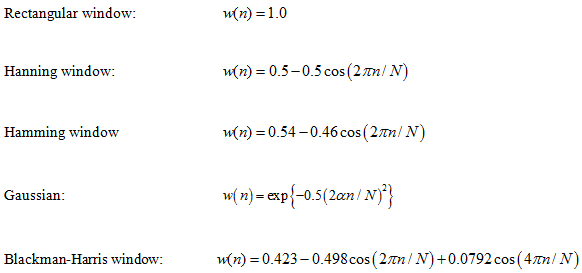
To decrease the leakage error due to discrepancy between the time duration measured and the period of the original signal, we must connect the repeated wave smoothly. For this purpose we multiply a weighting function that decrease gradually at both sides. This weighting function is called time window. Representative time windows are: the Hanning window, Hamming window, and Blackman-Harris window are shown in Figure 14.30. These windows along with some more are defined in the range: 0 ≤ n ≤ N -1 as
|
(14.30) |

Various window functions along with a typical signal with discontinuity at the junction point are shown in Figs. 14.31-14.33. Effects on the leakage error by window functions on the spectrum are shown in Fig 14.34 (a-d). Fig. 14.34 shows a signal in frequency domain without windowing. There is a main frequency peak and around that smaller peaks can be seen as the leakage error. When windowing is applied the corresponding to leakage error the peaks get suppressed as compared to the main frequency.
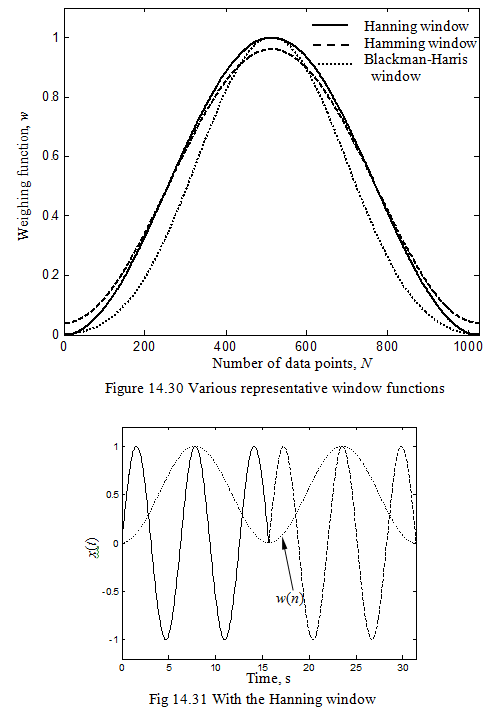
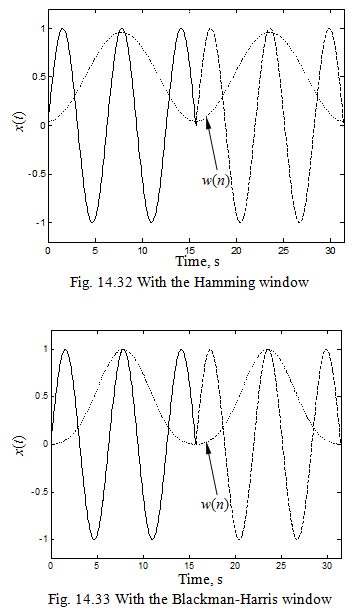
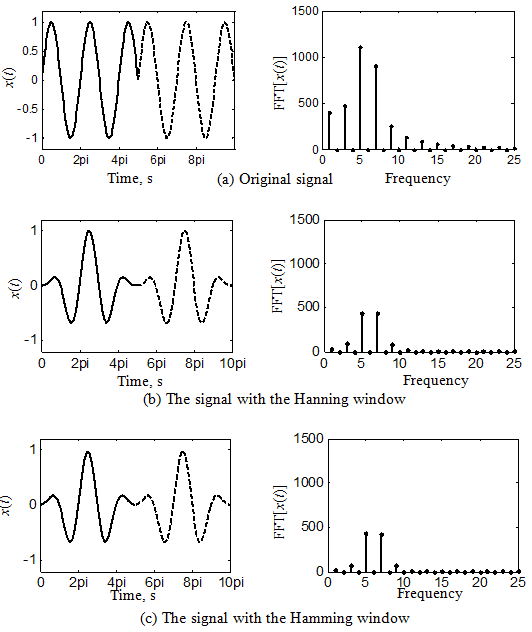
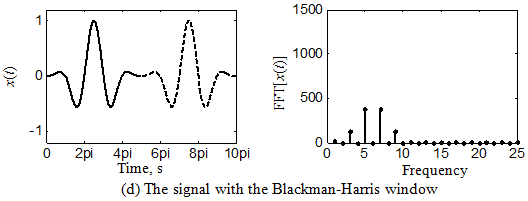
Fig. 14.34 Illustration of leakage error and application of various window functions on a same signal
For a discussion of their characteristics and the effects of these window functions, refer to books on the signal processing (e.g., Bendat and Piersol, 2010).
(iii) Prevention of leakage by coinciding periods: As discussed above, we can obtain the correct result (i.e., the main frequency peak) if the time duration measured coincides with the integer multiple of the period of the original signal. If we can attain this by some means, it is better than the use of window functions, which distorts the original signal. For example, for numerical calculations that can be repeated in exactly the same way and whose sampling interval can be adjusted freely, we can determine the measurement duration after we know the period of the original signal by trial simulation, and then execute the actual numerical simulation. On the contrary, for experiments, fine adjustment of sampling intervals is generally impossible using practical measuring instruments. However, if the phenomenon appears within a speed range, we can change the rotational speed little by little and adopt the best result where the period, often determined by the rotational speed, and the sampling interval fit.