14.8 Applications of FFT to Rotor Vibrations
In the investigation of rotor vibration, we must know the direction of a whirling motion as well as its angular velocity. In FFT (or DFT), elements of data sequence {xk} obtained by sampling are considered as real numbers and those of data sequence {xn} obtained by discrete Fourier transform are considered as complex numbers. In the following, we introduce a method that can distinguish between whirling directions utilizing the revised FFT. In this FFT, rotor whirling motion is represented by a complex number by overlapping the whirling plane on the complex plane and applying FFT to these complex sampled data. Let us assume that a disc mounted on a elastic shaft is whirling in the y-z-plane. We get sampled data {yk} and {zk} by measuring the deflections and in the y and z directions respectively. Taking the y-axis as real axis and the z-axis as imaginary axis, we overlap the whirling plane on the complex plane. Using sampled data yk and zk, we define the complex numbers as follows:
|
(14.31) |

Fig. 14.35(a) shows sub-harmonic vibration component of ½ order in vibration signal. In Figs.14.35(b) and (c), the same spectrum are shown with windowing and tuning of sampling interval, respectively, for clarity of the frequency components. Fig. 14.36 shows the complex-FFT with distinct forward and backward whirl frequency components.
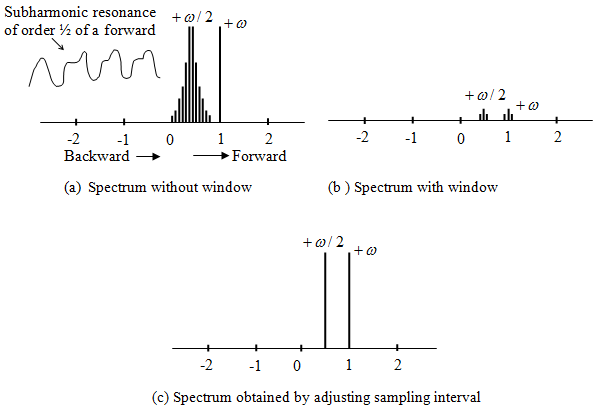
Figure 14.35 Spectra of the sub-harmonic resonance of ½ order of a forward whirling mode
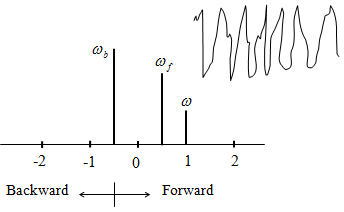
Figure 14.36 Spectrum of the combination resonance (complex FFT method)