14.9.6 Auto-correlation Function and Covariance
The autocorrelation is defined as

The prefix auto refers to the fact that x1x2 represents a product of values on the same sample at two instants. For fixed t1 and t2 this average is simply a constant; however, in subsequent applications t1 and t2 will be permitted to vary and the autocorrelation will in general be a function of both t1 and t2. In an important special case the autocorrelation function is a function only of  .
.
A related average, the covariance is obtained by averaging the product of the deviation from the means at two instants. Thus, we have the covariance as
|
(14.60) |

When x1 and x2 have zero means, the covariance is identical to the auto-correlation. When t1 = t2, the covariance becomes identical with the mean square.
A frequency decomposition of the  can be made in the following way
|
(14.61) |
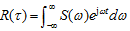
where S(ω) is the Fourier transform of , except for the factor 2π. A physical meaning can be given to S(ω) by considering the limited case of equation (14.61) in which the time shift  is taken
|
(14.62) |
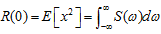
The mean square of the process equals the sum over all frequencies of S(ω)dω so that S(ω) can be interpreted as a mean square spectral density. It should be noted that the dimensions of S(ω) are mean square per unit of circular frequency. Note that according to equation (14.62) both negative and positive frequencies are considered, which is convenient for analytical investigations. In experimental work a different unit of spectral density is widely used. The difference arises due to the use of cycles per unit time (Hz) in place of rad/s and due to considering only positive frequencies. The experimental spectral density will be denoted as W(f) where f is frequency in Hz.
|
(14.63) |

with
|
(14.64) |

From above equation, the relationship between S(ω) and W(f) is simply
|
(14.65) |
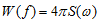
The factor 4π is made up of a factor of 2π accounting for the change in frequency units and a factor of 2 accounting for the consideration of positive frequencies only, instead of both positive and negative frequencies for an even function of frequency.