14.9.3 Stationary and Ergodic Process
Often the random process is simplified and is assumed to be stationary process. This assumption is analogous to the assumption of steady state forced response in deterministic vibration.
Displacement, x(t), at a particular location in test rig measured under identical conditions for n number of times will have the following form: x(1)(t),x(2)(t),....,x(m)(t) ≡ {x(t)}, which is called the random process. These are the same physical quantities, however, they will not themselves be identical but will have certain statistical properties in common. A random process is said to be stationary if its probability distributions are invariant under a shift of the time scale of the signal. For example, the random process will be stationary when displacements x(1)(tn),x(2)(tn),....,x(m)(tn) have probability distributions independent of time tn(n=1,2,....). By ergodic we mean the probability distribution x(1)(tn),x(2)(tn),....,x(m)(tn) of at any one time is equal to the probability distribution of any one displacement signal x(j)(t) with respect to time. Hence, an ergodic signal will be stationary, however, a stationary signal will not necessarily be ergodic. That means ensemble and temporal averages of the ergodic signal will be same, whereas, these averages are different for the stationary process. It should be noted that for the ergodic process a signal will be enough to define the statistical properties of the process completely.
For a stationary process, in particular the probability density p(x) becomes a universal distribution independent of time. This implies that all the averages based on p(x) (e.g., the mean E[x] and the variance σ2 = E[x2] - (E[x])2) are constants independent of time. The autocorrelation function is defined as
|
(14.46) |
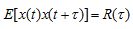
which is also independent of t and function of time lag  (for present case
  and t1 = t). It should be noted that R(0) reduces to the mean square E[x2]. In case x has zero mean, E[x] = 0, then the mean square is identical with the variance and R(0) = σ2. The stationary assumptions can be verified for experimental signals by calculating the mean and auto-correlation functions at different times and checking for its invariance.
There are certain properties of autocorrelation function and its derivatives which are useful in analysis. The autocorrelation function is an even function, since for the stationary random process we can write
|
(14.47) |

Using a prime to indicate differentiating with respect to the contents of a bracket, on differentiating both sides of the above equation with respect to  we get

or,

or,
|
(14.48) |

For  , we have from above
  , which is only true when both are zero.
Hence,
, which is only true when both are zero.
Hence,
|
(14.49) |

Similarly,
|
(14.50) |

where equation (14.47) has been used. Now, for , we have
|
(14.51) |
