Module 2 : Molecular Structure
Lecture 9 : Polyatomics
  9.5

Molecular Geometry

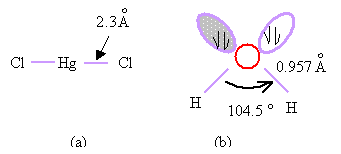
This is a topic which has always remained at the center of attention of chemists. Chemistry has progressed with increasing knowledge of molecular geometry. The tetrahedral geometry of CH4, the planar nature of benzene, the tunnel structure of pyramidal shape of ammonia, helical structure of proteins and the double helical structure of DNA and the emerging structures of nanomaterials are all problems in extended molecular and material structures. We will consider a few representative examples. Once a minimum energy configuration of a collection of atoms is arrived at, the molecular geometry gets defined. In water, the HOH bond angle is 104.5o and the bond length is 0.957 .

Figure (9.6) The structure of (a) HgCl2 and (b) H2O


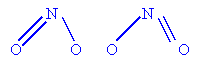
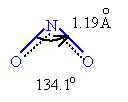
CO2 is a linear structure while NO2 is bent. The bent structure of NO2 and the equivalence of the two NO bonds can be explained by the two resonance structures of NO2 (Fig 9.7).


Figure 9.7 (a) The two resonance structures of NO2


Figure 9.7 (b) Structure showing the equivalence of the two NO bonds
 
In water, the hybridization in O is sp3. The HOH bond angle is less than the tetrahedral (109o 48') angle because of the strong lone pair - lone pair repulsion between the two lone pairs in water. In NO2, although the hybridization on N is sp2, the ONO bond angle is 134.10 because of the repulsion between the two NO bonds. Qualitative concepts such as lone pair - lone pair repulsion being greater than bond -pair- lone pair repulsion are very useful in rationalizing the deviations of chemical structures from the expected structures based on hybridization, differences in electronegativity, size differences and so on.