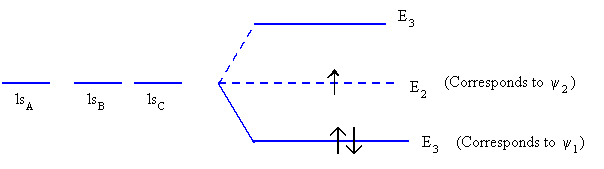
For the second MO, we chose 1sA - 1sC. Had we chosen (i) 1sA - 1sB, an equally acceptable candidate would have been (ii) 1sC - 1sB or any combination of these two. We have actually chosen the difference of these two (i) - (ii)] which has a greater degree of symmetry / asymmetry. For the third MO we take the sum of these two. The three MOs for linear H3 are
(r1) = 1sA (r1) + 1sB(r1) + 1sC(r1)
(9.1)
(r3) = 1sA (r3) - 1sC(r3)
(9.2)
(r) = 1sA (r) - 21sB(r) + 1sC(r)
(9.3)
When the second electron is placed in , we assign the coordinate r2, to it giving (r2). This will have a spin opposite to the spin of the electron described by (r1) so that the wave function does not disobey the Pauli exclusion principle.The third electron goes to. There is no electron in . The energy of H3 depends on how much lower is compared to the 1s level of an isolated H atom and also the relative placement of .
Here 1sA (r1) is the 1s orbital of a hydrogen atom labeled A and r1 is the electron coordinate. Note that has one node and has two nodes. This is a routine feature now. As the energies keep increasing, so do the number of nodes. An energy level diagram for H3 is shown in fig 9.2.

 (r1) = 1sA (r1) + 1sB(r1) + 1s
 (r3) = 1sA (r3) - 1s
 (r) = 1sA (r) - 21sB(r) + 1s
 . The energy of H3 depends on how much lower is