Module 2 : Molecular Structure
Lecture 9 : Polyatomics
  9.4

Overlap diagrams of d-orbitals.

We have already studied the overlap diagrams of s and p orbitals in lectures 7 and 8. We shall consider the overlap diagrams of d orbitals here. Just as s and p orbitals combine to form , * , and orbitals, d orbitals can also overlap to give bonding and antibonding combinations. We will consider combinations between two d orbitals of two atoms. Combinations between d and s and d and p can be constructed by analogy.

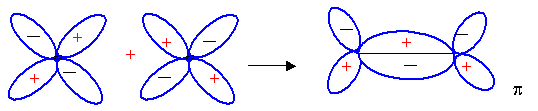
The "head on" overlap of d orbitals gives a sigma bond (comparison to p is confusing) and is shown in fig 9.5 (a). The "sideways" overlap of two d orbitals gives a orbitals which is shown in fig 9.5 (b) . This MO has a plane of symmetry which contains the molecular axis and is perpendicular to the plane of paper. The third kind of overlap is also sideways but with each lobe of the d orbitals facing a corresponding lobe of the other. This third type of overlap is called a bond. In and bonds [ fig. 9.5(a) and (b) ] only one or two lobes overlapp. bond occurs in quadruple bonding which is found among bimetallic compounds of transition elements.


Fig 9.5 (a) bond from two d orbitals.


Figure 9.5 (b) bond from two d orbitals.


Figure 9.5 (c) bond from two d orbitals.
 
Figure 9.5 Orbital overlap diagrams for different types of bonds using d orbitals.
 

By comparing Fig 9.5 with the corresponding figures of lectures 7 and 8, construct the antibonding combinations.