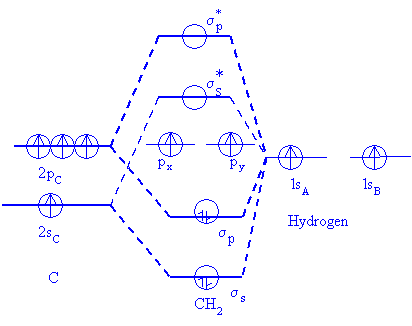
We shall consider three more triatomics, namely CH2, XeF2 and H2O. Water is a stable molecule. XeF2 is not as strongly bonded as water and CH2 is a radical. Their MO diagrams are shown in Fig 9.3 (a), (b) and (c). In CH2, the four orbitals of carbon (2s, 2px, 2py and 2pz) and the two 1s orbitals of the two hydrogen together form the six MOs as shown in fig 9.3 (a). The 1s orbital of C is not shown as it is much lower in energy. One of the two electrons of the 2s orbital is shown "promoted" to 2p. In CH2, there are two bonding pairs (
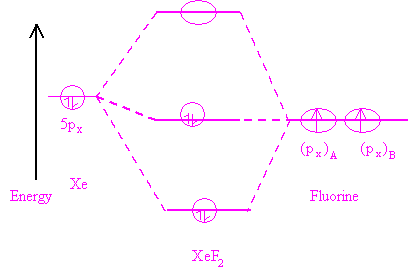
s and ) of electrons and two unpaired electrons (in px and py; which are non bonding) to give CH2 the free radical character. In XeF2 (fig 9.3 (b)), the paired electrons in a 2p orbital of Xe interact with two electrons (one each in a px orbital of each F) of F to give two pairs of bonding electrons.
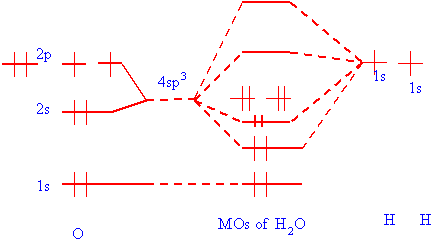
The "old" concept that rare gases do not form molecule due to their "closed" shell is gone! All (and the only thing!) that is needed to form a stable species is that in the MOs formed, there should be more number of electrons in bonding orbitals. Even if the numbers are equal, some stability can arise if the lowering in energy due to bonding MOs is more than the rise in energy due to the occupied antibonding MOs. Fig 9.3(c) shows the bonding in H2O. Formation of four hybrid orbitals in O (from the 2s and the three 2p orbitals) is shown in the figure. There are two pairs of bonding electrons and two pairs of "non bonding" electrons on the oxygen. These are the lone pairs. These principles illustrated in simple triatomics work in other larger molecules. We shall next turn to the details of hybridization.

 s and
s and  ) of electrons and two unpaired electrons (in px and py; which are non bonding) to give CH2 the free radical character. In XeF2 (fig 9.3 (b)), the paired electrons in a 2p orbital of Xe interact with two electrons (one each in a px orbital of each F) of F to give two pairs of bonding electrons.
