The case of benzene, which is a cyclic or ring compound, can be studied in a similar fashion. There are six p electrons (one on each carbon atom) in p orbitals perpendicular to the molecular plane. Starting with 6 p orbitals, we get six orbitals, 1 to 6 as shown below in Fig 9.11 and the coefficients are given in Eq 9.11. The energy levels are shown in fig 9.11 (b).
Figure 9.11 (a) The molecular orbitals of benzene (b) The energy level diagram.
= + + + + +
(9.7a)
= - - - + +
(9.7b)
= + - -
(9.7c)
= + - + + -
(9.7d)
= - + -
(9.7e)
= - + - + -
(9.7f)
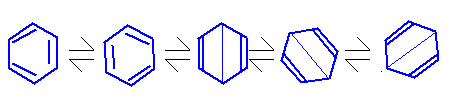
MOs and are degenerate. The six bonding electrons are placed in , and . The antibonding orbitals are , (degenerate) and . Benzene is "aromatic". The word aromatic does not simply refer to the odour of the molecule but it also refers to the additional stability in the molecule resulting from the spread of orbitals throughout the six carbon atoms of the ring. If the three bonds in benzene were separate, the stabilization due to the three double bonds would be approximately three times the stability due to an isolated double bond as in ethylene. But the stabilization in benzene is 36 kcal/mol more than the stabilization due to three separate double bonds. This is called as stabilization due to "resonance" and the following pictures reflect this feature.

 orbitals,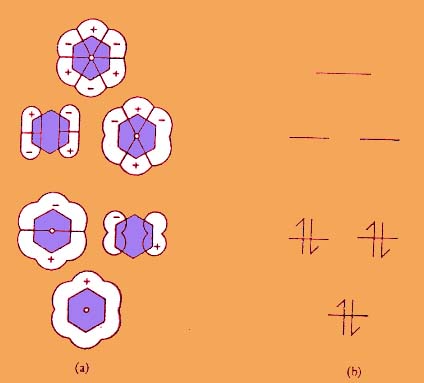
 =
=  +
+  +
+  +
+  +
+  +
+ 
 =
=  -
-  -
-  -
-  +
+  +
+ 
 =
=  +
+  -
-  -
- 
 =
=  +
+  -
-  +
+  +
+  -
- 
 =
=  -
-  +
+  -
- 
 =
=  -
-  +
+  -
-  +
+  -
-