An MO is a function of the coordinates of an electron. To plot a function of x, y, z, we need a four dimensional plot and this is clearly not possible. The other simpler options for plotting the MO are:
a)
Plot contour diagrams (a contour connects the points on which the values of the MO are constant) in two or three dimensions and indicate the value of the MO on the contour
b) Plot the values of the MO and the AOs with the inter-nuclear axis taken as the x axis and the values of the function plotted on the y-axis. and
c) Show the pixel plots (charge density plots of the squares of the wave function. In such a plot, dense points indicate the regions where the value of is large and sparse points correspond to regions wherein the values of are low.
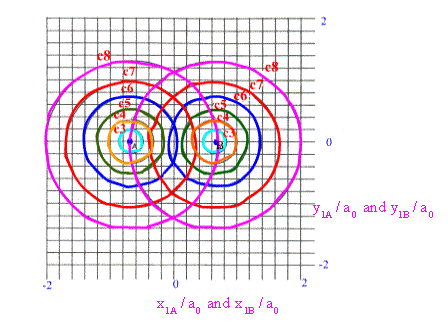
In fig 7.3 (a) the contour diagram of the atomic orbitals centered on the atoms A and B is shown in the xy plane. There are two atoms A and B and for each orbital on atoms A and B, there are two coordinates in the plane, ie, x1A and y1A for the orbital on atom A and x1B and y1B for the orbital on atom B. We consider the s orbitals, ie e -r1A/a 0 and e –r1B/a0 . The distance from the centers A and B are r1A and r1B . The z coordinate is not considered since we are plotting the values of the function in the xy plane.
Figure 7.3 (a) Contour diagram of a bonding molecular orbital in H2+ at rAB = 0.74
Fig 7.3(b) Contours of the two atomic orbitals on the two hydrogen atoms A and B are shown for comparision with the molecular orbital.

 is large and sparse points correspond to regions wherein the values of
  are low.