Module 2 : Molecular Structure
Lecture 7 : Homonuclear Diatomic Molecules
  7.1
Introduction

The study of atomic structure dealt with the Schrödinger equation for atoms, atomic energy levels, charge densities and “filling up” the atomic orbitals with electrons using the aufbau principle as well as the Pauli exclusion principle. In the case of molecular structure too, the approach is similar. The Schrödinger equation has to take into account the presence of more than one nucleus and the interaction of each electron with all the nuclei and all the other electrons. In a commonly used method, the atomic orbitals are replaced by molecular orbitals (MOs). Like atomic orbitals, molecular orbitals are also functions of the coordinates of an (a single) electron.


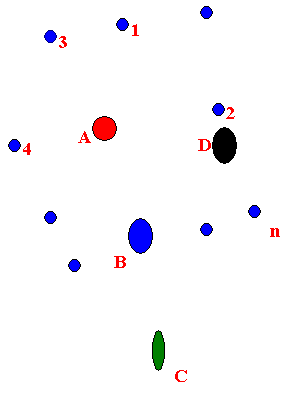
The value of this function (MO) depends on the positions of all the nuclei, which are generally considered fixed for the purpose of calculating MOs. This is reasonable, since the nuclei are far heavier than the electrons. Before beginning our study on homonuclear diatomics, let us see how the Schrödinger equation for a molecule looks like. In the following figure, A, B, C and D are the nuclei and 1,2,3 ….n are electrons.


Fig 7.1 Coordinates of nuclei (A, B, C, D, filled circles, considered to be fixed) and electrons (1,2,3,4,….n, shown as dots) of a molecule.