Lecture 29 : Temperature Dependence of Reaction Rates
But since we want the right side to be unity, C (
/ b) 1 / 2 = 1 or C = ( b / ) 1/2 and
(29.21)
From a probability distribution such as f ( x), average quantities can be easily determined. The averages of x and x2 are given by
(29.22)
(29.23)
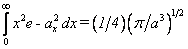
In eqs (29.22) and (29.23), averages are denoted by < >. We have also used another standard integral,
The integral in eq (29.22) is zero because the value of the integrand for positive x is equal and opposite to its value at - x and thus the area corresponding to the integral on the left of x = 0 is equal and opposite in sign to the area on the right. This is a special case of a general result that the integral of the product of an even function and an odd function of x is zero over a symmetric interval around zero.
To evaluate eq (29.23), we take the help of the kinetic theory of gases. Do look up the derivation. The pressure of a gas is given in terms of the mean square velocity (speed) as
p = (1/3) (N/ V ) m < 2>
(29.24)
Where N/ V = number of molecules of the gas / volume = the density of the gas. But N = n N A where n = number of moles and N A the Avogadro number. Since pV = nRT, we have
pV = (1/3) Nm <2 > = 1 / 3 n NA m < 2> = nRT
(29.25)
<2> = 3 RT / mNA = 3 k B T / m
(29.26)
Where kB = R / NA is the Boltzmann constant, 1.38 * 10 -23 J / K. Since <2> = 3 kB T / m, we have <x>2 = kBT/ m and substituting this in eq (29.23), we get

 / b) 1 / 2 = 1 or C = ( b /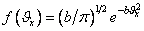
 x and
x and 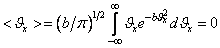

 2>
2> 
