Lecture 29 : Temperature Dependence of Reaction Rates
Example 29.2
Using the standard formulae for the translational, rotational and vibrational energy levels, calculate the molecular translational, vibrational and rotational partition functions.
Solution
a) The translational partition function, qtrans.
A molecule confined inside a box of length L has the translational energy levels given by Etrans = h2 / 8 mL2 (nx2 + ny2 + nz2 ) where nx, ny and nz are the quantum numbers in the three directions.
(29.36)
qtrans= qx qy qz, the product of translational partition functions in the three directions.
(29.37)
Since the levels are very closely spaced, we can replace the sum by an integral
(29.38)
using eq 29.20, this becomes
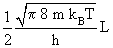
q x = 1/2 (
/a) 1 / 2 =
(29.39)
Multiplying qx, qy and qz, we have, using V = volume of the box = L3
q trans = [ 2 m k B T / h2 ] 3 / 2 V
(29.40)
This is usually a very large number (1020) for volumes of 1 cm3. This means that such a large number of translational states are accessible for occupation by the molecules of a gas.
b) The rotational energy levels.
E rot =
J (J + 1 ) where
= h2 / 82I
(29.41)
In the summation, qrot = , we can do an explicit summation if only a few terms contribute. The factor (2J+1) for each term accounts for the degeneracy of a rotational state J. The partition function is a sum over states. If energy EJ is degenerate with (2J + 1) states corresponding to it, the Boltzmann factor
has to be multiplied by (2J+ 1) to account for all these states. If the rotational energy levels are placed very close to one another, we can integrate similar to what we did in (a) above to get.
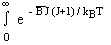
q rot =
(2J + 1) d J
(29.42)
=
e - a x d x where a =
/ kBT and x = J 2 + J, dx = (2J + 1) dJ
q rot = 1/ a = kBT /
(29.43)
c) The vibrational energy levels
= (
+1/2 ) h
where
is the vibrational frequency and is the vibrational quantum numbers.
In this case, it is easy to sum the geometric series shown below




 J (J + 1 ) where
 , we can do an explicit summation if only a few terms contribute. The factor (2J+1) for each term accounts for the degeneracy of a rotational state J. The partition function is a sum over states. If energy EJ is degenerate with (2J + 1) states corresponding to it, the Boltzmann factor
 has to be multiplied by (2J+ 1) to account for all these states. If the rotational energy levels are placed very close to one another, we can integrate similar to what we did in (a) above to get.
 (2J + 1) d J
  e - a x d x where a =
 / kBT and x = J 2 + J, dx = (2J + 1) dJ
 = (
= (
 +1/2 ) h
 where
where
 is the vibrational frequency and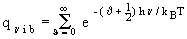

 ( 1 + x + x2 + x3....)
  which is less than 1
  if the zero of energy scale is at
  .
. 
