Lecture 29 : Temperature Dependence of Reaction Rates
Example 29.3
Find the electronic partition of H2 at 300 K.
Solution
The lowest electronic energy level of H2 is near - 32 eV and the next level is about 5 eV higher. Taking - 32 eV as the zero (or reference value of energy),
qe = e 0 + e -5 ev / kT + ...
(29.46)
At 300 K, k BT = 0.02eV and qe = 1 + e -200 +...
Where all terms other than the first are nearly 0. This implies that qe = 1. The physical meaning of this is that only the ground electronic state is generally accessible at room temperature.
Example 29.4
Express the partition function (Q) of a collection of N molecules in terms of the molecular partion function q.
Solution
Assuming molecules to be independent, the total energy E of molecules is a sum of individual molecular energies E i and
= q q q q q q q q .................... q = q N
(29.47)
Here
,
....
are energies of individual molecules 1, 2, ................N, and a sum of all Es can only come from summing over all
s. GIbbs postulated that Q = qN / N!.
(29.48)
The N ! in the denominator is due to the indistinguishability of the tiny molecules (or other quantum particles in a collection).
Example 29.5
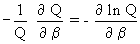
Show that the average energy <E> of the system above is given by -
ln Q /
Solution :
In the collection of N molecules, how many molecules (ni) have the energy Ei?This has to be N e / Q using eq (29.32). This is because the fraction of molecules ni / N having the energy Ei is e / Q which is the same as the probability of finding a molecule with energy Ei in the collection. The average energy is obtained by multiplying E i with its probability and summing over all i . i.e.,


 ,
,
 ....
....
 are energies of individual molecules 1, 2, ................N, and a sum of all Es can only come from summing over all
 s. GIbbs postulated that Q = qN / N!.
  ln Q /
 / Q using eq (29.32). This is because the fraction of molecules ni / N having the energy Ei is e