| |
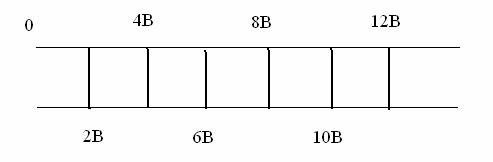
In addition to this requirement, the molecule has to possess a dipole moment. As a dipolar molecule rotates, the rotating dipole constitutes the transition dipole operator μ. Molecules such as HCl and CO will show rotational spectra while H2, Cl2 and CO2 will not. The rotational spectrum will appear as follows |
| |
Fig. 13.3 Rotational spectrum of a rigid diatomic. Values of B are in cm-1. Typical values of B in cm-1 are 1.92118 (CO), 10.593 (HCl), 20.956 (HF), 1H2 (60.864), 2H2 (30.442), 1.9987 (N2). |
| |
From the value of B obtained from the rotational spectra, moments of inertia of molecules I, can be calculated. From the value of I, bond length can be deduced.
Example 13.1: Calculate the value of I and r of CO. B = 1.92118 cm-1.
Solution:
I = h/(8π2 Bc) = 6.626 x 10 -34/(8 x 3.14152 x 1.92118 x 3 x 1010)
= 1.45579 x 10-46 kg m2
Since the value of B is in cm-1, the velocity of light c is taken in cm/s. I = μr2. The atomic mass of C ≡ 12.0000 amu, O ≡ 15.9994 amu. 1 amu = 1.6604 x 10⁻²⁷ kg. The reduced mass of CO can be calculated to be 1.13836 x 10⁻²⁷ kg.
Therefore r2 = I/µ = 1.45579 x 10-46/1.13826 x -27 m2
Or r = 1.131 Ǻ |