13.5 |
Vibrational spectra of Polyatomics |
| |
An atom moving in three dimensions has three degrees of freedom corresponding to the freedom in movement in, say, the x, y and z directions. A collection of N unabound atoms will have 3N degrees of freedom. If the N atoms are bound through the formation of a molecule, the 3N degrees of freedom get redistributed into translational rotational and vibrational modes. Since the molecule can be translated as a unit, there are three translational modes (degrees of freedom). Similarly there are three rotational modes with respect to three independent axis of rotation. The remaining, 3N-6 are the vibrational modes. For a linear molecule, since there are only two rotational modes with respect to the two axes perpendicular to the molecular axis, there are 3N-5 vibrational modes.
If the potentials energy functions for all the motions can be assumed to be harmonic, then the 3N-6 modes can be categorized into 3N-6 normal modes. Consider the example of water. There are three atoms and 3N-6 = 3 normal modes. In terms of the potential energy functions for vibrations, there are three functions: one each corresponding to each O-H bond and one corresponding to the H-O-H bending. In terms of the individual bond vibrations, the vibrational motion can appear quite complex. The total potential energy P.E. may be written as:
P.E. = ½ k (r1-r10)2 + ½ k (r2 – r20)2 + ½ k′(θ-θ0)2 (13.26)
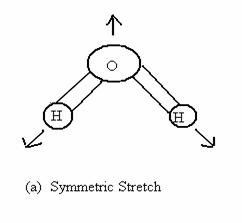
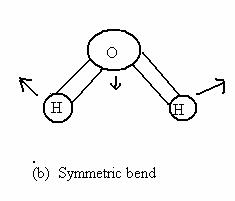
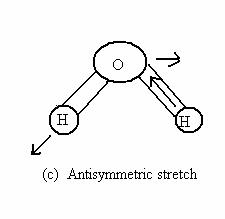
Here, r10 and r20 are the equilibrium bond lengths of the two O-H bonds and θ0 is the equilibrium bond angle. A normal mode of vibration is defined as a vibration in which all atoms oscillate with the same frequency and pass through their equilibrium positions at the same time. The center of mass is unchanged during a normal mode. The three normal modes of vibration of water are shown in the following figure.
|
| |
Figure 13.7 Normal modes of vibrations of water |