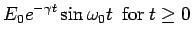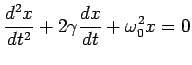
where 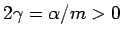 . (It may be noted that in classical electromagnetic theory the radiation damping term is proportional to . (It may be noted that in classical electromagnetic theory the radiation damping term is proportional to  , whereas our model assumes it to be proportional to , whereas our model assumes it to be proportional to  itself. This is actually of no consequence as the solution being sine and cosine functions, any even number of derivative would do.) itself. This is actually of no consequence as the solution being sine and cosine functions, any even number of derivative would do.)
The solution of the above equation for small damping (  ) gives damped oscillations ) gives damped oscillations
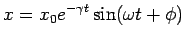
|

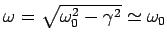 .
.  , we have