A He-Ne laser has a gas discharge temperature of 400 K. The atomic mass of Ne (which is responsible for lasing) is kg. If the lasing wavelength is 630 nm, calculate the lineshape broadening due to Doppler effect.
Solution:
The Doppler frequency broadening is given by
using , the FWHM for wavelength is given by
Substituting the numerical values, nm.
2.6
Consequence of Line Broadening:
We have seen that the atomic energy levels are broadened due to both homogeneous and inhomogeneous effects. As a result of this, the energy separation between the two laser levels itself is centred around some frequency with a spread . The line shape distribution corresponding to this transition will be denoted as .
The laser is forced to operate at a signal frequency with a width . In practice . For instance for Ruby, the line width while the laser output width is typically to .001 nm. Thus the signal may be

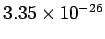 kg. If the lasing wavelength is 630 nm, calculate the lineshape broadening due to Doppler effect.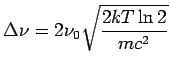
 , the FWHM for wavelength is given by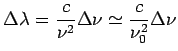
 nm.
nm.  with a spread
  . The line shape distribution corresponding to this transition will be denoted as
  .
. with a width
  . In practice
  . For instance for Ruby, the line width
  while the laser output width is typically
  to .001 nm. Thus the signal may be
