As there is a distribution of velocities, there will be a distribution of resonant frequencies. As 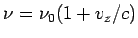 , we may substitute , we may substitute 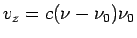 in the expression for in the expression for  and get an expression for the lineshape function and get an expression for the lineshape function 

where
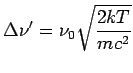
is the distance from the central maximum of the frequency value at which the probability is  times the maximum value. It is often convenient to use the full width at half maximum (FWHM), which is defined as the distance between the points on either side of the central maximum, where the probability (or the intensity) is half its maximum value. Defining this to be times the maximum value. It is often convenient to use the full width at half maximum (FWHM), which is defined as the distance between the points on either side of the central maximum, where the probability (or the intensity) is half its maximum value. Defining this to be  , the expression for the lineshape function becomes , the expression for the lineshape function becomes

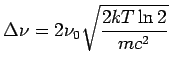
where the FWHM value  is given by is given by
|


