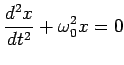
where 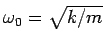 . The motion of the electron is oscillatory, . The motion of the electron is oscillatory, 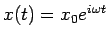 . The total energy of the electron . The total energy of the electron  is constant. The model does not take into account the power that an oscillating electron radiates. In classical electrodynamics, an accelerating charge emits radiation, the emitted power being given by the Poynting vector is constant. The model does not take into account the power that an oscillating electron radiates. In classical electrodynamics, an accelerating charge emits radiation, the emitted power being given by the Poynting vector  . The total power radiated by a dipole is given by . The total power radiated by a dipole is given by
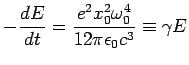
which shows that the radiated energy is proportional to the instantaneous energy. We may model the situation by modifying our equations of motion for the electron to include a damping term proportional to the velocity (  ) ) |

 . The equation of motion of the electron is given by
