Natural linewidth is an inherent width associated with any energy level due to quantum mechanical uncertainty principle. According to this principle, if  is the minimum uncertainty in the lifetime of an atom in an energy level, the uncertainty in determining the energy level itself is given by is the minimum uncertainty in the lifetime of an atom in an energy level, the uncertainty in determining the energy level itself is given by
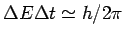
Using  , the relation may be written as , the relation may be written as
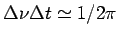
Thus in a two level system, there is an width associated with both the upper and lower levels. This, in turn, implies that there is an inherent width in the frequency of photons emitted due to the transition. In a typical transition, the excited state lifetime is  seconds. The corresponding linewidth is about 16 MHz. seconds. The corresponding linewidth is about 16 MHz. |

 is a complicated function which depends on the transition involved and also on external factors. The broadening of spectral lines is classified into two major categories :
