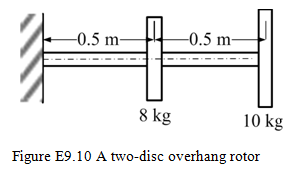
Exercise 9.6 For Exercise E9.2 when the left and right discs have respectively diametral mass moment of inertias as , obtain the transverse natural frequencies and mode shapes of the rotor system.
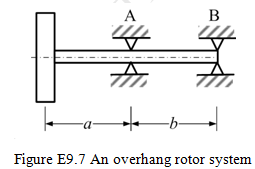
Exercise 9.7 Obtain transverse natural frequencies of a rotor system as shown in Figure E9.7. The mass of the disc is kg and the diametral mass moment of inertia is Id = 0.02 kg-m2. Shaft lengths are a = 0.3 m and b = 0.7 m, the diameter of the shaft is 10 mm and the modulus of elasticity of the shaft is E = 2.1 x 10 11 N/m2. Consider two different cases i.e. when bearing A is (i) a simple support and (ii) a flexible support, which provides a bending stiffness equal to 5 percent of the bending stiffness of a cantilevered shaft segment having length a . Bearing B is a fixed bearing.
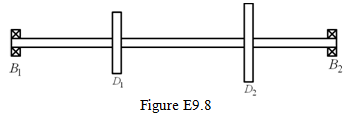
Exercise 9.8 Find the bending critical speeds and mode shapes of the rotor system shown in Figure E9.8. B1 and B2 are bearings, which provide simply supported end condition and D1 and D2 are rigid discs. The shaft is made of steel with modulus of rigidity E = 2.1 (10)11 N/m 2 and uniform diameter d = 10 mm. Various shaft lengths are as follows: B1 D1 = 50 mm, D1D2 = 75 mm, and D2B2 = 50 mm. The mass of discs are: Consider the shaft as massless. Consider the following cases (i) neglect the diametral mass moment of inertia of both discs and (ii) take
  kg-m2and
  kg-m2.