9.7.1 Static (Guyan) reduction
The method essentially consists elimination of certain degrees of freedom. The degrees of freedom eliminated in this process are called slaves and those retained for the analysis are called masters. Generally retained coordinates (masters) would coincide with lumped discs, bearing locations, unbalance or balancing plane locations, and any other external force locations. Discarded coordinates (slaves) would correspond to points in the model, which are non-critical, or of secondary interest such as rotational DOFs, intermediate location on the shaft, etc. In identification of system parameters since it is not possible to measure responses at all DOFs in practical situation, this is overcome by applying the static reduction to governing system equations. The state vector  , the force vector
 , the mass matrix
  and the stiffness matrix
 , are partitioned into sub-vectors and matrices relating to the masters degrees of freedom, which are to be retained, and the slaves degrees of freedom, which are to eliminated. If no force is applied at the slave DOFs, a general governing finite element equations can be partitioned as

with

where subscripts m and s represent the master and the slave, respectively. As the name suggests the static reduction (or condensation) is based on the assumption that the excitation frequencies are such that the inertia terms are negligibly small as compared to the stiffness term. This might happen with the engineering approximation when the excitation frequency range is relatively low. However, it has been reported that error involved in such approximation in the estimation of natural frequencies and unbalance responses are acceptably low even at high frequency range. Neglecting inertia terms for the second set of equations in equation (9.116)gives

and from the identity, we have

On combining equations (9.119)and(9.118) , we obtain the static transformation as



........
with

Equation (9.121) is the reduced form of the system governing equation and due to this the overall size of the matrices to be handled greatly reduces and in turn the computational time. With the damping and gyroscopic matrices also the same transformation as in equation (9.120) is valid and the reduced damping and gyroscopic matrices take the following form

While development of the static reduction transformation all dynamic effects, i.e., the mass, damping and gyroscopic effects are ignored.
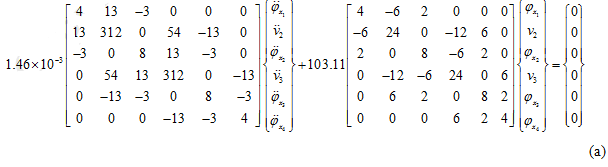
Example 9.10 For Example 9.2 apply the static condensation and eliminate all the rotational-DOF from the assembled equation of motion for three elements. Subsequently, obtain transverse natural frequencies of the rotor system.
Solution : The reduced form of the FE equation in example has the following form (Equation (e))