Exercises:
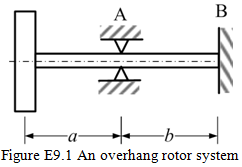
Exercise 9.1 Obtain transverse natural frequencies of a rotor system as shown in Figure E9.1. The mass of the disc is m = 5 kg and the diametral mass moment of inertia is Id = 0.02 kg-m2. Lengths of the shaft are a = 0.3 m and b = 0.7 m. The diameter of the shaft is 10 mm. Bearing A has the roller support and Bearing B has the fixed support condition. Consider (i) neglect the mass of the shaft and (ii) retain the mass of the shaft.
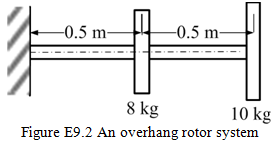
Exercise 9.2 Find transverse natural frequencies of the rotor system shown in Figure E9.2. Take EI = 2 MN-m2 for the shaft and the mass moment of inertia of the disc is negligible.
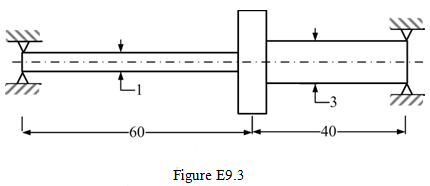
Exercise 9.3 Find the transverse natural frequency of a rotor system as shown in Figure E9.3. Consider shaft as massless and is made of steel with 2.1 (10)11 N/m2 of Young's modulus, E, and 7800 kg/m3of mass density, ρ. The disc has 10 kg of mass. The shaft is simply supported at ends (In Figure E9.3 all dimensions are in cm). [Answer: rad/s]
Exercise 9.4 For exercises 9.1 to 9.3 plot the translational and rotational displacements (with both amplitude and phase) of discs with respect to the rotational speed of the rotor (take the rotational frequency of the rotor minimum of 0.1 rad/s and maximum at least 5 rad/s above the second critical speed of the rotor system). Assume imbalances of 20 gm-mm at one of the disc with 30-degree phase with some shaft reference point. Check whether critical speeds are in agreement with the obtained by free vibration analysis.
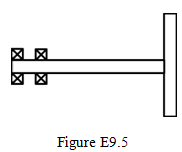
Exercise 9.5 Obtain the bending natural frequency of a rotor as shown in Figure E9.5. The rotor is assumed to be fixed supported at one end. Take mass of the disc m = 2 kg and its diametral moment of inertia 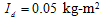 . The shaft is assumed to be massless, and its length and diameter are 0.2 m and 0.01m, respectively. Take the Young's modulus
 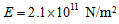 for the shaft material.