So that
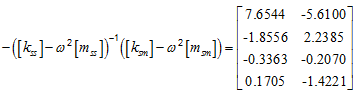
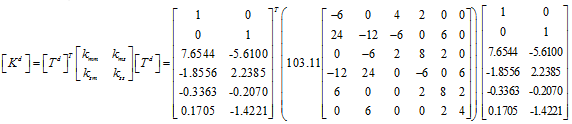
Hence, the dynamic transformation is
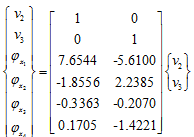
Hence, the reduced form of the matrix becomes

with
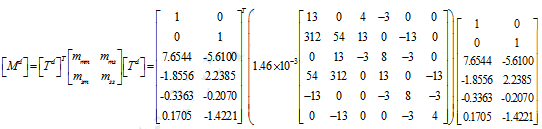
or
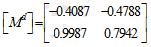
and
or
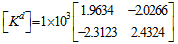
Hence, we have the following eigen value problem

For which eigen values and eigen vectors are

which gives natural frequencies as

On comparison with Examples 9.2 and 9.9 with the same number of elements it could be seen that not much difference in the determined natural frequencies even with the condensations of some of DOFs. However, now the size of the matrix has decreased drastically from 6×6 to 2×2. The difference between the condensed and non-condensed cases would be very less when we will have very large DOFs system. The present example, in fact illustrate the method but not the potential of the dynamic condensation as such.
Concluding Remarks
To brief, in the present chapter we considered transverse vibration of continuous system for some simple boundary conditions. Closed form expressions of natural frequencies and mode shapes (eigen functions) are summarised for various simple boundary conditions. The main focus of the present chapter is to analyse the free and forced vibrations by using the finite element method. Using Galerkin's method elemental equation of Euler-Bernoulli beam model is derived. Applications of various simple boundary conditions like the simply supported, over-hanged, intermediate supports, etc. have been illustrated through examples. The purpose of the examples are to have clarity of intermediate steps involved in the formulation of the elemental and assembled governing equations, application of boundary conditions, and extraction of modal parameters and forced response information. The proportional damping or Raleigh's damping is described. The static and dynamic condensation schemes are described in detailed, which are used to reduce the size of matrices to be handled for final solution of either the eigen value problem or to obtained the forced response. The forced response of simple rotor systems are obtained for most common type of excitation, i.e., unbalances. However, the analysis can be easily extended for other periodic forces by using the Fourier analysis, as any periodic force can be written as the sine and cosine series form. Fourier series will be dealt in more detail in subsequent chapters. In next chapter, we will continue with the finite element analysis of rotors by including some higher effects like gyroscopic effects, the rotary inertia, and the shear deformation; which are predominant for at high spin speeds and thick rotating shafts.