(iii) For the flexible shaft and rigid bearings (Method 2): Now the influence coefficient method is used. Bearing forces are given as

where the reaction forces from the disc can be expressed as
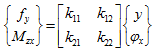
with

where

Displacement vectors are related with the unbalance force as
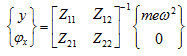
with

In view of above equations, bearing reaction forces can be written as
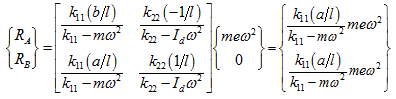
From above equations, we have

and
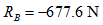
which is same as by previous method. It would be interesting to vary the spin speed and plot the bearing forces with it. It should be noted since the disc is at the mid-span, hence there is no contribution of the diametral mass moment of inertia on to bearing reactions. If there had been couple unbalance then the diametral mass moment of inertia would have affected bearing reactions. As an exercise take the disc location from the left support a = 0.3 l and obtain bearing bearings for the same.
Example 2.8. Find the transverse natural frequency of a rotor system as shown in Figure 2.29. Consider the shaft as massless and is made of steel with 2.1(10)11 N/m2 of the Young’s modulus, and 7800 kg/m3 of the mass density. The disc has 10 kg of the mass. The shaft is simply supported at ends.
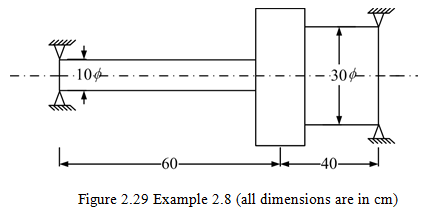
Solution: Considering only the linear displacement, first we will obtain the stiffness (or the influence coefficient,  ) for Figure 2.30 using the energy method. On taking the force and moment balances, we have

which gives reaction forces as

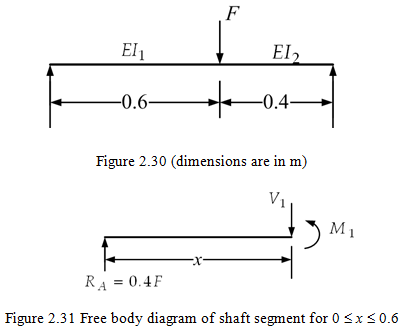
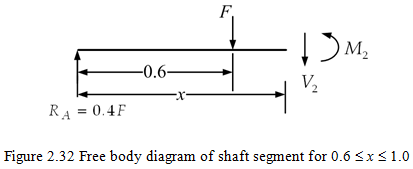
Bending moments are obtained at various segments of the shaft to get the strain energy of the system. On taking the moment balance in the free body diagram as shown in Figure 2.31 of a shaft segment for 0.0 ≤ x ≤ 0.6, we get
 |
(a) |