Example 2.5 Find the bending natural frequency of a rotor system shown in Figure 2.23. The disc is rigid and has mass of 10 kg with negligible diametral mass moment of inertia. Consider the shaft as massless and flexible with E = 2.1 X 10¹¹ N/m2. Take one plane motion only.
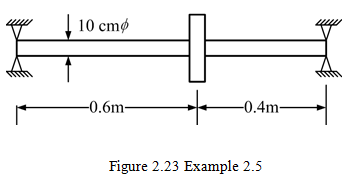
Solution: Figure 2.23 shows the deflected position of the shaft. For a simply supported beam, the influence coefficient is defined as (Timoshanko and Young, 1968)
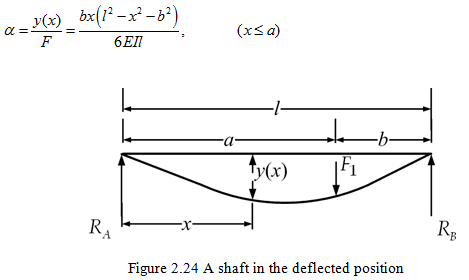
For obtaining  (which is defined as the deflection at station 1 for the unit force at station 1),we have z = 0.6 m, l = 1.0 m and b = 0.4 m. Hence, it can be obtained as

Considering a single plane (y-z) motion and neglecting the rotational displacement Φx, the natural frequency can be obtained as (refer section 2.5.1)
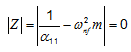
which gives

Example 2.6: Obtain transverse natural frequencies of an offset Jeffcott rotor system as shown in Figure 2.25. Take the mass of the disc, m = 10 kg, the diametral mass moment of inertia, Id = 0.02 kg-m2 and the disc is placed at 0.25 m from the right support. The shaft has the diameter of 10 mm and total length of the span is 1 m. The shaft is assumed to be massless. Use the influence coefficient method. Take shaft Young’s modulus E = 2.1 X 10¹¹ N/m2. Neglect the gyroscopic effect and take one plane motion only.
Solution: Influence coefficients for a linear and angular diaplacements (y, φ) correspoding to a force (f) and a moment (M) acting at the disc are defined as
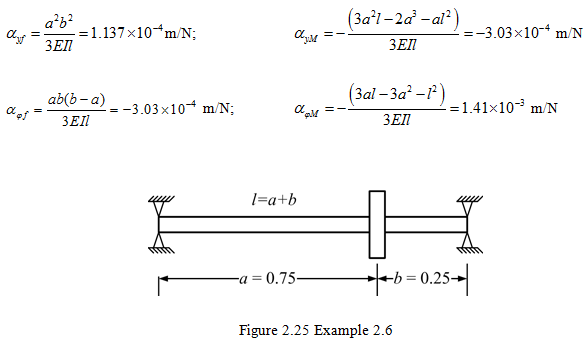
For the present problem only single plane motion is considered. For free vibration, from equation (2.81), we get
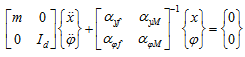
Since it will execute the SHM for the free vibration, we have
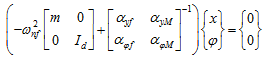
where ωnf is the natural frequency of the system. Above equation is an eigen value problem. For non-trivial solution, we have
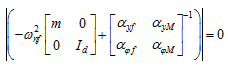
which gives a frequency equation in the form of a polynomial, as

On substituting values of the present problem parameters, it gives

It can be solved to give two natural frequency of the system as

For the present problem the linear and angular displacements in a single plane are coupled. Since natural frequencies obtained are system natural frequencies and hence are not as such related to the pure translational or pure rotational motions. If we consider these two motions are uncoupled, then corresponding natural frequencies can be obtained as

and

It can be seen that there is a small difference in the fundamental natural frequency due to pure translation motion (29.65 rad/s) with that of the fundamental natural frequency of the coupled system (29.4 rad/s), and a large difference in the natural frequency for the pure tilting motion (188 rad/s) with the second natural frequency of the coupled system (290 rad/s).