Exercise 2.10: For the Jeffcott rotor consider pure rotational displacement (tilting) of the disc (without linear displacement) and obtain transverse natural frequency for the tilting motion.
[Hint: The stiffness due to titling motion would be 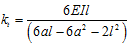 and the diametral mass moment of inertia would be
  . Hence, the natural frequency would be
  .]
.]
Exercise 2.11 What should be the length and the diameter of a cantilever shaft if the bending critical speed has to fixed at 100 Hz and has 2 kg of mass at its free end? Because of the space limitation the length of the shaft must be less than 30 cm. [Answer: l = 0.3m and d = 0.0288 m].
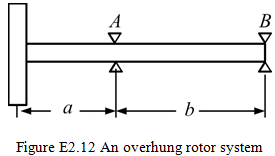
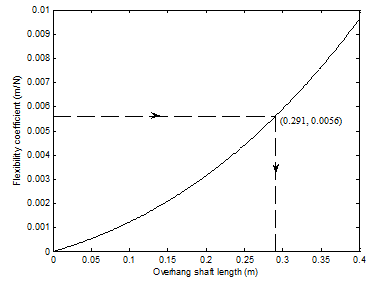
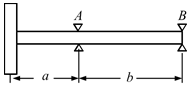
Exercise 2.12 The transverse critical speed of a rotor system as shown in Figure E2.12 is to be fixed at 5.98 rad/s. Take disc as a point mass with m = 5 kg. What should be the overhung shaft length, a? Take shaft length b = 0.7 m. The diameter of the shaft is 10 mm. Neglect the gyroscopic effect. [Answer: 0.291 m]
[Solution:
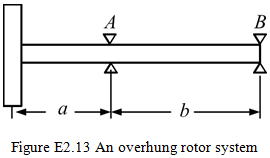
Exercise 2.13 The transverse critical speed of a rotor system as shown in Figure E2.13 is to be fixed at 5.98 rad/s. Take disc as a point mass with m = 5 kg. What should be the diameter of the uniform shaft, d? Take shaft length a = 0.3, b = 0.7 m. Neglect the gyroscopic effect. [Answer: 0.01m]
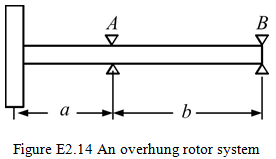
Exercise 2.14 The transverse critical speed of a rotor system as shown in Figure E2.14 is to be fixed at 5.98 rad/s. Take disc as a point mass with m = 5 kg. What should be the diameter of the uniform shaft, d? Take shaft length 2a = b = 0.7 m. Neglect the gyroscopic effect. [Hint:  or
or  ; Answer: 5.222 mm]
Exercise 2.15 For a Jeffcott rotor with a disc at the mid-span, influence coefficients are given as:  , where l is the span length and EI is the modulus of rigidity of the shaft. Let m and Id be the mass and the diametral mass moment of inertia, respectively, of the disc. Obtain the natural frequencies of the rotor system.
[Answer:  and
and  ] .
] .
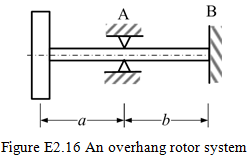
Exercise 2.16 Obtain transverse natural frequencies of a rotor system as shown in Figure E2.16. The mass of the disc is m = 5 kg and the diametral mass moment of inertia is Id = 0.02 kg-m2. Lengths of the shaft are a = 0.3 m and b = 0.7 m. The diameter of the shaft is 10 mm. Bearing A has the roller support and Bearing B has the fixed support condition. Neglect the mass of the shaft and gyroscopic effect of the disc. E = 2.1 (10)11 N/m2.
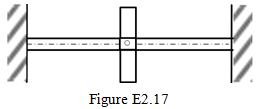
Exercise 2.17 Consider a rotor system as shown in Figure E2.17 for the transverse natural frequency. Two flexible massless shafts are connected by a coupling (i.e., a pin joined). A thin disc of mass 3 kg is attached to one of the shaft (let us take toward the left side shaft) and it is not interfering the relative motion between the two shafts. Other ends of shafts have fixed conditions. Take the length of each of the shaft as 0.5 m and the diameter as 0.05m. Young’s modulus E = 2.1 (10)11 N/m2.
Exercise 2.18 Choose a single correct answer from the multiple choice questions:
- The critical speed phenomenon of a rotor is a
- free vibration
- forced vibration
- transient vibration
- unstable vibration
- A rigid body is defined as
- a body with no deformation
- a body with their particles have fixed distances
- both (A) and (B)
- either (A) or (B)
- A particle has how many degrees of freedom
- 1
- 2
- 3
- more than 3
- A rigid body has how many degrees of freedom
- 1
- 2
- 6
- more than 6
- A flexible body has how many degrees of freedom
- 1
- 3
- 6
- infinite
- If three points have fixed relative distances between them, then it represents a system of
- single particle
- a rigid body
- a flexible body
- none of the above
- A system consists of three particles with their relative distances as constant, then it has how many degrees of freedom
- 1
- 3
- 6
- infinite
[Hint: A single particle has three DOF, one additional particle in the system will add only two more DOF, since it has one constraint to maintain the fixed distance. The third particle will add only one more DOF, since it has two constraints to maintain fixed distances from the first as well as the second particle. Hence, a system consists of three particles with their relative distances as constant have total six DOF, i.e., same as a rigid body.]
- A perfectly balanced Jeffcott rotor (i.e., a flexible shaft with a disc at mid span) when it is rotating at a particular speed, if it is perturbed in transverse plane from its equilibrium then the frequency of whirl would be equal to
- the shaft spin speed
- the transverse natural frequency
- the more transverse natural frequency
- the less transverse natural frequency
- In a Jeffcott rotor with an off-set disc (i.e., not at the mid-span) and if the disc has a tilt in the transverse plane. The shaft would experience
- A gyroscopic couple
- an external moment
- either (A) or (B)
- both (A) and (B)
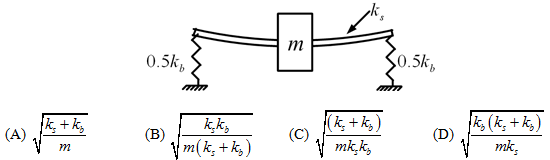
- The transverse natural frequency of the rotor-bearing system shown below would be
- For a Jeffcott rotor operating at super critical speeds (i.e., well above the critical speed), the rotor deflection would be approaching to

- infinite
- zero
- eccentricity
- For a Jeffcott rotor operating at critical speed, the rotor response phase with respect to the unbalance force would be approaching to
- 0°
- 90°
- 180°
- some finite value depending upon the damping value
- The transverse critical speed of a rotor system as shown below is to be fixed at 5.98 rad/s. Take disc as a point mass with m = 5 kg. What should be the diameter of the uniform shaft, d? Take shaft length 2a = b = 0.7 m. Neglect the gyroscopic effect. [Influence coefficient ]
- 4.25 mm
- 4.43 mm
- 5.10 mm
- 5.22 mm
[Answers: (i) B (ii) C (iii) C (iv) C (v) D (vi) B (vii) C (viii) B (ix) D (x) B (xi) D (xii) B (xiii) D]