In general, if A has distinct eigenvalues, it can be diagonalized using similarity transformation. Consider a square matrix A which has distinct eigenvalues
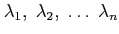 . It is required to find a transformation matrix P which will convert A into a diagonal form
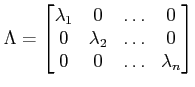
through similarity transformation AP = P∧
. If
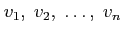 are the eigenvectors of matrix A corresponding to eigenvalues
, then we know
are the eigenvectors of matrix A corresponding to eigenvalues
, then we know
 . This gives
![$\displaystyle A\left[v_1\;v_2\;\ldots\;v_n\right]=[v_1\;v_2\;\ldots\;v_n]\begin...
...bda_1&0&\ldots&0\\
0& \lambda_2&\ldots&0\\
0&0&\ldots& \lambda_n\end{bmatrix}$](images/img37.png)
![$ P=\left[v_1\;v_2\;\ldots\;v_n\right]$](images/img38.png) . Consider the following state model.
. Consider the following state model.

 to
to
 through the relation
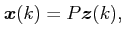 or,
or,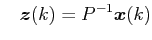
then the modified state space model becomes

where
 .
.
3. Computation of 
We have seen that to derive the state space model of a sampled data system, we need to know the continuous time state transition matrix
 .
.
3.1 Using Inverse Laplace Transform
For the system
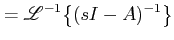
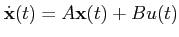 , the state transition matrix e At can be computed as,