1. Characteristic Equation, eigenvalues and eigen vectors
For a discrete state space model, the characteristic equation is defined as
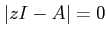
The roots of the characteristic equation are the eigenvalues of matrix A.
1. If  , i.e., A is nonsingular and
  ,
,  ,
,  ,
,  are the eigenvalues of A, then,
 ,
,
 , ,
, ,
 will be the eigenvalues of A-1.
2. Eigenvalues of A and AT are same when A is a real matrix.
3. If A is a real symmetric matrix then all its eigenvalues are real.
The  vector
  which satisfies the matrix equation
 |
(1) |
where
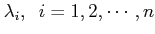 denotes the ith eigenvalue, is called the eigen vector of A associated with the eigenvalue
  . If eigenvalues are distinct, they can be solved directly from equation (1).
Properties of eigen vectors
1. An eigen vector cannot be a null vector.
2. If is an eigen vector of A then  is also an eigen vector of A where m is a scalar.
3. If A has n distinct eigenvalues, then the n eigen vectors are linearly independent.
When the matrix  an eigenvalue
  of multiplicity
  , a
full set of linearly independent may not exist. The number of linearly
independent eigen vectors is equal to the degeneracy
, a
full set of linearly independent may not exist. The number of linearly
independent eigen vectors is equal to the degeneracy  of
of
 . The degeneracy is defined as

where  is the dimension of and
  is the rank
of
. Furthermore,
is the rank
of
. Furthermore,

2 Similarity Transformation and Diagonalization
Square matrices A and  are similar if
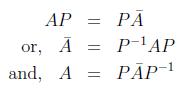
The non-singular matrix P is called similarity transformation matrix. It should be noted that eigenvalues of a square matrix A are not altered by similarity transformation.
Diagonalization:
If the system matrix A of a state variable model is diagonal then the state dynamics are decoupled from each other and solving the state equations become much more simpler.