| Radiance and reflectance
|
- Radiance and reflectance are a few of the most important concepts for RS. This section will explain these quantities are interrelated and related to other measurements.
- To convert the irradiance onto target into radiance towards the detector, we need to consider the reflectance properties of materials which are usually function of wavelength, illumination angle, and viewing angle.
- The proportions of energy reflected, absorbed, and transmitted varies for different earth features, depending on their different material type and condition which allows us to distinguish different features on an image.
- The wavelength dependency of these interactions implies that, even with a given feature type, the proportion of reflected, absorbed and transmitted energy will vary at different wavelengths. Thus, two different features may be indistinguishable in one spectral range, and be very different in another spectral range.
- Radiance at a particular point is a function of position (x, y) as well as the direction ( ω ) and hence describes angular distribution of radiation. The irradiance is the addition of all radiances integrated over certain range of solid angles. These are interrelated as follows:
|
 |
- Different types of reflectances are mentioned in literature which are described now.
|
|
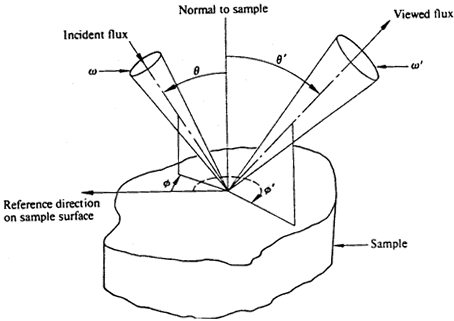
| Consider the figure which indicates various geometric parameters describing reflection from a sample surface. In this figure, θ = zenith angle, Φ = azimuthal angle, Ω = beam solid angle; A prime on a symbol refers to viewing (reflected) conditions (Swain and Davis, 1978)
|
| |
|