| Bidirectional Reflectance Factor (BRF)
|
- Since BRDF is difficult to measure, another term, BRF, is defined. It is the ratio of flux reflected by a target under specified conditions of irradiation and viewing to that reflected by an ideal, completely reflecting, perfectly diffuse surface, identically irradiated and viewed.
- BRF is easy to measure and, under certain assumptions, can be directly related to BRDF. The measurement method for BRF is based upon the utilization of a perfectly diffuse, completely reflecting surface as a reference.
|
| Perfectly diffuse surface
|
- It is a surface that reflects equally in all directions (sometimes called as Lambertian reflector ). Radiance of a uniformly illuminated Lambertian surface of infinite extent is constant for any viewing angle, θ'.
|
| Completely reflecting surface
|
- All flux falling on surface is reflected from the surface (M = E for a perfectly reflecting surface).
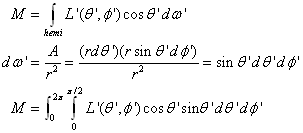
- If a uniformly viewing illuminated Lambertian surface is small enough to fill the FOV of an observing sensor, the radiance received & measured by the sensor is proportional to the cosine of the viewing angle.
|
| Thus for an ideal reference surface the radiant exitance (M) is given by (Swain and Davis, 1978)
|
|
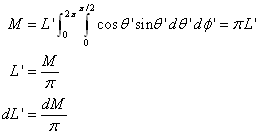
| Since magnitude of L ' ( θ', Φ ' ) is independent of ( θ', Φ' ) for a perfectly diffuse surface, we have:
|
|
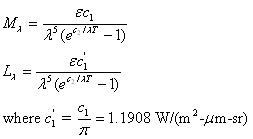
| This equation has been derived for a perfectly diffuse reflecting surface. However, the result is equally applicable to Lambertian radiating surface. Thus for a Lambertian BB radiator, we can write
|
|
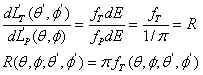
| For perfectly reflecting surface M = E, and using the definition for BRDF (subscript p refers to ideal (perfect) diffuser)
|
|
| Thus ratio of the reflected radiance (numerator of the BRDF) of a target to the reflected radiance of a perfectly reflecting diffuser can be determined ( T refers to target).
|
| Under the assumption of an ideal reference surface, the easily measured BRF is directly relatable to the BRDF.
|
| Usually, the reference target is prepared coating the surface with barium sulphate. Properly prepared barium sulphate (or magnesium oxide) references closely approximate perfect diffusers for θ ≤ 450, but depart from the completely reflecting assumption at some wavelengths. The left-side of above equation can be obtained from the measured BRF, hence referred to as R', by using the relation:
|
|
| ρ s spectral reflectance of the reference surface
|