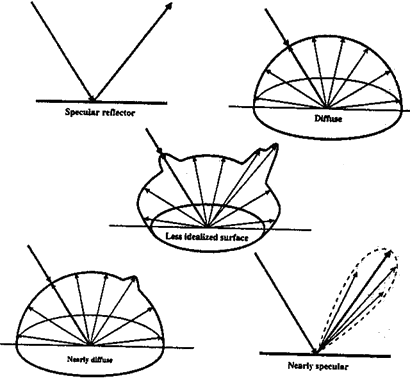
| Geometrical factors affecting reflectance from a surface
|
- The geometric manner in which an object reflects energy is also an important consideration and is mainly a function of surface roughness. Radiation is reflected, absorbed or transmitted at the interface of the surface. The nature of the reflection at the interface depends upon:
- Angle of incidence of the energy.
- Surface roughness as a function of wavelength; and
- Materials on either side of the surface, as they will affect the angle of refraction and the percentages that are reflected, absorbed and transmitted at the interface.
- There are two broad categories of reflectors based on surface roughness (Figure):
(a) Specular reflector
(b) Lambertian or Diffuse reflectors
|
|
| Reflectance characteristics of idealised surfaces (Schott, 1997)
|
(a) Specular reflectors
|
- When a surface is smooth, we get specular or mirror-like reflection where all (or almost all) of the energy flux is directed away from the surface in a single direction exactly opposite to the incident ray. A nearly specular surface or quasi-specular surface will appear to have most of the reflected energy concentrated in cone about the specular ray. A less-idealised surface may appear brighter in specular and backscatter direction and darker when viewed at grazing angles.
- Reflectance of specular surfaces is highly dependent on the geometric relationship between the source (usually the Sun), the surface elements and the sensor.
- The smoother the surface, the more specular or mirror-like the reflectance is likely to be, i.e., the greater the proportion of the energy will be reflected in accordance with Snell's Law (which states that the angle of reflection equals angle of incidence).
- With specular surfaces, the closer the incident ray is to the normal from the surface, or the smaller the angle of incidence, the lower the level of reflectance that is likely to occur. With the increase in incidence angle the reflectance is likely to increase, particularly when the ray becomes a grazing ray, or the angle of incidence approaches 900. Due to this reason water appears more reflective at large angles of incidence.
|
| (b) Lambertian or Diffuse reflectors
|
| Diffuse reflection occurs when the surface is rough and the energy is reflected almost uniformly in all directions. Such surface has same radiance in all direction and has little or no directional character to their reflectance.
|
- A nearly diffuse surface or quasi-Lambertian surface will generally appear brighter in the specular direction.
- With the increase in surface roughness, the reflection becomes increasingly scattered in direction resembling the Lambertian reflectance, where the Lambertian reflectance is defined as reflectance that scatters or reflects the energy equally in all directions, independent of the angle of incidence of the incident energy.
- As surfaces become more Lambertian their reflectance becomes less dependent on this geometric relationship. The closer the surfaces are to the Lambertian ideal, the better they are from the remote sensing perspective. In reality, however, very few surfaces are perfectly Lambertian reflectors, so few have reflectance characteristics that are completely independent of this geometric relationship.
|
|