Module 4 : Remote Sensing
  Lecture 29: Physical basis of remote sensing ( Radiometry )
Angular distribution of radiation
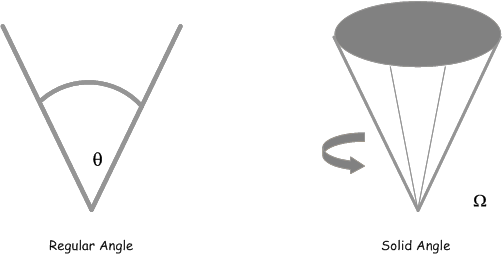
To account for geometrical distribution of radiation, we use the concept of solid angle ( Ω ) with units of steredian (sr). A solid angle is similar to a regular angle, except it covers a 2D area instead of a 1D distance.
For any surface  
For sphere, total surface area = 4πR2. Hence, there are 4π steredian over a sphere.
Radiance        A geometric radiation quantity that allows us to describe how radiation is distributed in space. It is defined later.
Point and extended source
We must distinguish between point and extended sources.

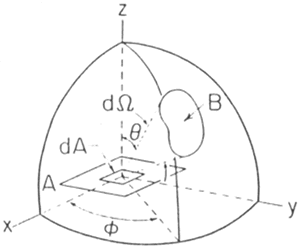
Point sources          For such sources, one uses the term radiant intensity, I = d Φ/d Ω which is defined as the flux                               per  unit solid angle into the direction defined by θ and Φ, where θ is the angle normal to a reference
                              surface, and Φ is an azimuthal angle.

Extended sources    For such sources, the radiation per unit area is important and we use terms like brightness                               and radiance. Both are defined as the radiant flux per solid angle per area projected in the                               direction  of radiation Incoming and outgoing radiations are called brightness (B) and radiance (L)                               respectively. Radianceis a geometric radiation quantity that allows us to describe how radiation                               is  distributed in space. It is defined later.

Brightness (B) and Radiance (L)
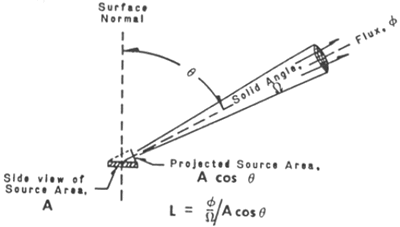
Brightness (B) is incoming radiant flux per solid angle (d Ω ) per area projected (dA cos θ ) on to the surface in the direction of radiation Radiance (L) is outgoing radiant flux per solid angle (d Ω) per area projected (dA cos θ ) on to the surface in the direction of radiation
 
  • Brightness equals the radiant flux,Φ, per solid angle,Ω, per projected area, Acos θ ; B = Φ/(Ω Acos θ )
  • In terms of infinitesimal quantities suitable for integrating:
                                              B = d2 Φ / (d Ω dAcos θ )
                                                             L = -B