Module 4 : Remote Sensing
  Lecture 29: Physical basis of remote sensing ( Radiometry )
Terminology
Energy (Q) Force [kg m/s2 ], exerted over a distance [m] with units of [kg m2/s2 ] or Joule (J). This form of energy is called Radiant Energy (Q)
Power ( F ) Rate at which energy changes in time. It produces a response in a satellite sensor. In RS literature, power is called Radiant Flux, Φ = dQ/dt with units of energy/time [J/s] = Watt (W)
Radiant flux ( F) Time rate of energy delivery, production, or propagation.
Flux Density (F) Radiant flux, or power per unit area. Units are: [W/m2].
In RS we are concerned with radiant flux over surfaces like a sensor lens or antenna.
Flux density (F) is referred to by two names:

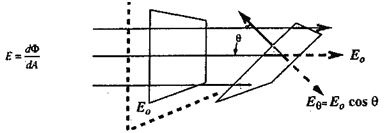
Irradiance (E)           Incoming flux density incident upon a surface ( dΦ/dA) or flux per unit area on to a surface


Figure: The first surface is perpendicular to incident flux and has irradiance E0. The second is rotated through an angle Θ and has flux Eθ (Schott, 1997)

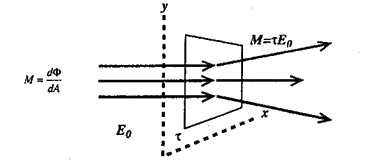
Emittance or radiant exitance (M)    Outgoing flux density emitted from a surface ( dΦ/dA)   or flux per unit area away from the surface.

Figure: A surface with E0 irradiance from the left and the transmission τ would have exitance M away from the right-hand side (Schott, 1997).
The units and expressions for both radiant exitance or emittance and irradiance are identical. The difference between these is that the radiant exitance refers to radiation that is leaving a surface or object of interest, whereas irradiance refers to the radiation that is incident on an object or surface of interest.