3-5.7 Preparation of Labeled Nucleotides:
Nucleotides can be labeled by isotopic and non-isotopic methods.
3-5.7.1 Isotopic labeling:
Isotopes generally used for labeling nucleotides are 32P, 33P, 35S or 3H. They can be detected directly in solution or on X-ray film using autoradiography.
Properties of radioisotopes used for labeling DNA and RNA probes:
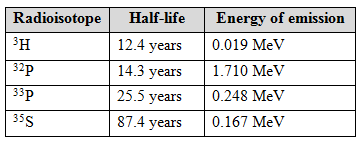
The strength of autoradiography signal depends on intensity of radiation emitted by radioisotope and duration of exposure. 32P emits high energy β-particles which offer high detection sensitivity. Thus, it is widely used in Southern blot hybridization, dot-blot hybridization, colony hybridization. But it is relatively unstable and when fine resolution is required to interpret results, the image is unambiguous due to its high energy β-particle emission. Due to this, 35S-labeled, 33P-labeled (moderate half-lives) and 3H-labeled nucleotides are used which emit less energetic β- radiation. They are used in DNA sequencing and in-situ hybridization. 3H requires long exposure time due to low energy β-particle emission. Due to this, 35S-labeled, 33P-labeled (moderate half-lives) and 3H-labeled nucleotides are used which emit less energetic β-radiation. They are used in DNA sequencing and in-situ hybridization. 3H requires long exposure time due to low energy β-particle emission.