Bohr's model of an atom, which was very successful in explaining the spectra of hydrogen like atoms is based on the following postulates :
Electrons move in stationary orbits around the nucleus. As long as an electron is in such an orbit, it does not y
radiate. However, it emits ( absorbs) radiation when it makes a discontinuous transition form an orbit with energy to an orbit of lower (higher) energy . The frequency of emitted (absorbed) radiation is given b
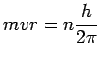
The angular momentum of an electron in a stationary orbit is an integral multiple of :
where is an integer.
Using Bohr model, one can show that the wavelength of the radiation emitted when an electron makes a transition from an orbit with quantum number to an orbit with , is given by

 to an orbit of lower (higher) energy
  . The frequency of emitted (absorbed) radiation is given b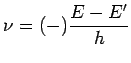
 :
: 
 is an integer.
  to an orbit with
  , is given by
