 |
Consider two extreme limits when the gamma ray photon is scattered by an angle  to the left extreme wall of the microscope. The x-component of the total momentum is the sum of the x component of the momentum of the scattered electron, to the left extreme wall of the microscope. The x-component of the total momentum is the sum of the x component of the momentum of the scattered electron,  and the x component of the momentum of the scattered photon, which is and the x component of the momentum of the scattered photon, which is
 , i.e. , i.e. 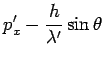 ,where ,where  is the wavelength of the scattered photon. is the wavelength of the scattered photon. |
| |
Similarly, when the photon is scattered to the extreme right, the total momentum is 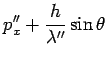 ,where  is the wavelength of the scattered photon. As the angle is small, the Compton shift  is small, and we may take  . The total x-component of the momentum incases must be the same, each being equal to momentum of the incident photon. |

