| |
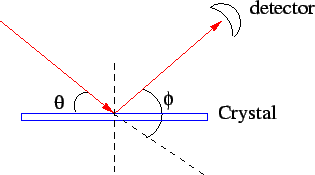
A beam of electrons from a heated filament, accelerated through a potential difference  is made to strike the surface of a crystal of Ni. Electrons are scattered in all directions and may be detected by an array of detectors located at various angles of scattering. It is found that the intensity of scattered beam is maximum at some particular angles of incidence, in the same manner as the case when a beam of x-rays strikes the crystal is made to strike the surface of a crystal of Ni. Electrons are scattered in all directions and may be detected by an array of detectors located at various angles of scattering. It is found that the intensity of scattered beam is maximum at some particular angles of incidence, in the same manner as the case when a beam of x-rays strikes the crystal |
| |
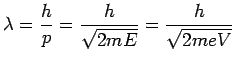
In Davisson - Germer experiment, the electron beam was accelerated through a potential difference of  volts. The kinetic energy volts. The kinetic energy  of the electron is thus 54 eV. The de Broglie wavelength associated with an electron accelerated through a potential difference may be expressed as of the electron is thus 54 eV. The de Broglie wavelength associated with an electron accelerated through a potential difference may be expressed as |