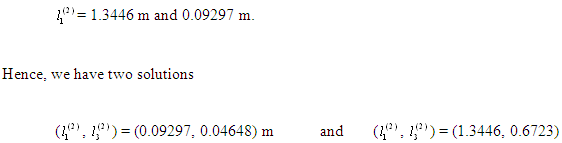
The two roots of  from this quadratic equation give positions of nodes for the one-node and two-node the vibration. The actual frequencies corresponding to these flexible modes are obtained by substituting the two values of in equation . From equation two values of
 could be obtained corresponding to two values of . Note that only one of these two values of may give the position of a real node, while the other gives the point at which the elastic line between discs 1 and 2, when produced, cuts the axis of the shaft (as shown in Fig 6.16(b) by the dotted line). Physically, it would mean that discs of two-disc rotor system will have angular displacement proportional to their axial location along the shaft. It could be seen that for single-node mode of vibration the three-disc rotor system could be considered as two cantilever rotor system (at either sides of the node location, which is chosen between discs 2 and 3) as shown in Fig. 6.16(b)), one with single disc (disc 3) whereas the other with two discs (discs 1 and 2). However, this will depend upon the node location, e.g. in the case the single node is between disc 1 and 2, then disc 1 will form a single-DOF cantilever rotor whereas discs 2 and 3 would form two-DOF cantilever rotor system.
For the present case, we started with two-node mode shape, however, similar exercise could be done with single-node mode shape. In this case we would have two equivalent rotor systems, with one as single-DOF cantilever rotor system and other as two-DOF cantilever rotor system. It is left to reader to explore the same. The present method can be extended for other boundary conditions (fixed-free, fixed-fixed, etc.) and for more number of discs, however, the complexity of handling higher degree of polynomials will be cumbersome. The present method is now illustrated through an example.
Example 6.5 Solve the Example 6.4 by the indirect method described in previous section.
Solution: From equation (6.45), we have

On substituting values of physical parameters of the present problem (Fig. 6.17a), we get
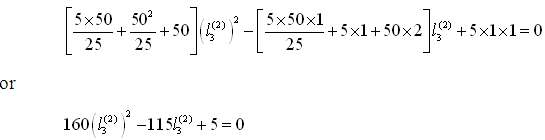
which gives two values corresponding to two modes (i.e., the one and two -node modes, Figs. 6.17 b and d), as
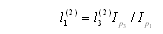
which gives two values corresponding to two modes (i.e., the one and two -node modes),as