Characteristic (or frequency) equations:
On equating the determinant to zero of the matrix in equation for a non-trivial solution, we get the characteristic equation of the following form

which gives torsional natural frequencies as
ωnf1=0;
and

| (6.28) |
Mode shapes can be obtained by substituting natural frequencies obtained, one by one, into the equations (6.27) and obtaining relative amplitudes with the help of any two equations (out of three equations), as
 |
(6.29) |
and
 |
(6.30) |
On substituting equation (6.29) in equation (6.30), we get
 |
(6.31) |
which can be simplified to
 |
(6.32) |
It should be noted that from equations (6.29) and (6.32) for ωnf1=0 , we have φz2/ φz1 =φz3/ φz1 =1 (or φz1= φz2=φz3 ) that belongs to the rigid body mode. Similarly, for the other two natural frequencies relative amplitudes of disc can be obtained by substituting these natural frequencies one by one in equations (6.29) and (6.32). For rotor systems with more than three discs expressions becomes cumbersome to handle by the direct method, and generally numerical methods would be essential to solve the frequency equation (i.e., the polynomial of higher degree).
An eigen value problem:
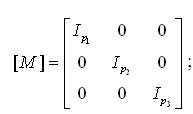
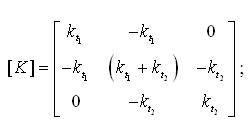
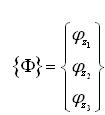
A more general method of obtaining of natural frequencies and mode shapes is to formulate an eigen value problem and that can relatively easily be solved by computer routines. Eigen values of the eigen value problem of equation (6.27) gives natural frequencies, and eigen vectors represent mode shapes. Equation (6.27) can be written as
 |
(6.33) |
with
 |
 |
 |