6.4 A Three-Disc Torsional Rotor System
Now the previous section analysis would be extended for the three-disc rotor system having free-free boundary conditions. Two different approaches are applied for the free vibration analysis to get the torsional natural frequencies and corresponding mode shapes.
6.4.1 A direct approach
A three-disc rotor system is shown in Fig. 6.12. It is assumed that there is no friction at supports and boundary conditions are that of the free-free case. The method using the Newton’s second law (or Lagrange’s equations), with the help of free body diagram (Fig. 6.13), may be applied to analyse the three-mass (or more) rotor system. This method is already demonstrated for the two-mass rotor system in the previous section.
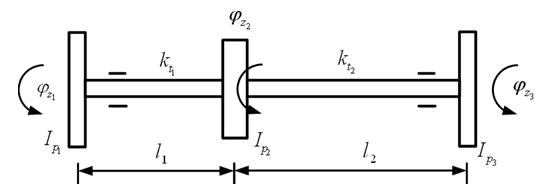
Figure 6.12 A three-disc torsional system
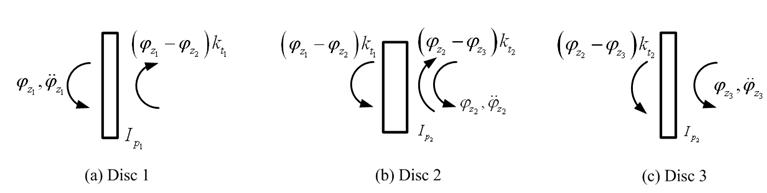
Figure 6.13 Free body diagrams of discs
From free body diagrams of individual discs three equations of motion for free vibrations can be obtained, and in the matrix form it has the following form
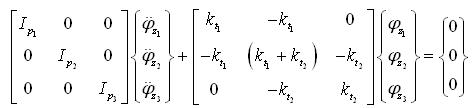 |
(6.26) |
For free vibrations, which has the SHM, it takes the form
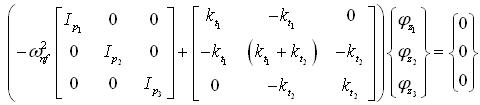 |
(6.27) |
where ωnf is the torsional natural frequency of the rotor system. For finding natural frequencies two methods can be adopted (i) by obtaining characteristic (or frequency) equations, and (ii) by formulating an eigen value problem.