Two-node Mode: For two-node vibration (see Fig. 6.16c), let l1(2) be the distance of one node from disc 1 (the superscript represent the two-node mode of vibration), and l3(2) the distance of the other node from disc 3. For this case the three-disc free-free rotor system could be considered as three single-DOF rotor systems (i.e., two cantilever rotor systems with discs 1 and 3, and one fixed-fixed rotor system with disc 2). Then the torsional natural frequency of the single-DOF cantilever system, with disc 1 and shaft length l1(2), is given as
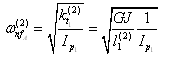 |
(6.38) |
Similarly, the torsional natural frequency of another single-DOF cantilever system (Figure 6.16c), with disc 3 and shaft length l3(2), is given as
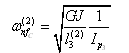 |
(6.39) |
For the single-DOF fixed-fixed rotor system (Fig. 6.16c), with disc 2 and shaft lengths at either sides of the disc as  the torsional natural frequency is
 |
(6.40) |
where
 |
(6.41) |
where  is the torsional stiffness of a rotor system with fixed-fixed end conditions. On substituting equation (6.41) into equation (6.40), we get
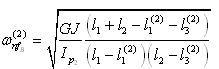 |
(6.42) |
Since for a particular mode all frequencies 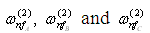 and must be equal (superscript represents the two-node mode). This leads to two independent equations to be solved for
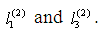 and . Once we know these node positions we could be able to get the natural frequency of the two-node (or one-node) mode. On equating equations (6.38) and (6.39), we get
 |
(6.43) |
Similarly, on equating equations (6.38) and (6.42), we get
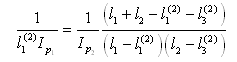 |
(6.44) |

 |
(6.45) |