From the theory of torsion of the shaft (Timoshenko and Young, 1968), we have
 |
(6.1) |
where kt is the torsional stiffness of shaft, Ip is the polar mass moment of inertia of the disc, J is the polar second moment of area of the shaft cross-section,  is the length of the shaft, d is the diameter of the shaft, and
  is the angular displacement of the disc (the counter clockwise direction is assumed as the positive direction). From the free body diagram of the disc as shown in Figure 6.1(b), we have
 |
(6.2) |
where Σ represents the summation operator, and two dots represents double derivative with respect to time. Equation (6.2) is the equation of motion of the disc for free torsional vibrations. The free (or natural) vibration has a simple harmonic motion (SHM). For SHM of the disc, we have
 |
(6.3) |
where  is the amplitude of the torsional vibration, and
  is the torsional natural frequency. On substituting equation (6.3) into equation (6.2), we get
 |
(6.4) |
Since  it gives
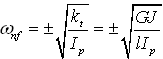 |
(6.5) |
which is similar to the case of single-DOF spring-mass system, where the polar mass moment of inertia and the torsional stiffness replace the mass and the spring stiffness, respectively. Only positive sign is considered, since the natural frequency can not be a negative quantity. It should be noted that equation of motion can also be derived by the Lagarange’s equation by considering the potential and kinetic energy of the system and it is left for the reader to verify it.