In previous chapters, mainly we studied transverse vibrations of simple rotor-bearing systems. It was pointed out that transverse vibrations are very common in rotor systems due to residual unbalances, which is the most inherent fault in a rotor. We studied behaviour of rotors due to speed-independent bearing dynamic parameters. Effect of gyroscopic couples on natural whirl frequencies and critical speeds have also been investigated in details. In the present chapter, we will extend the analysis of simple rotors to torsional vibrations. We will start with the analysis of torsional vibrations of the single disc rotor, two-disc rotor, and three-disc rotor systems with the conversional Newton’s second law of motion or energy methods. The analysis is extended to the stepped shafts, simple geared systems, and branched geared systems. For the multi-DOF rotor system a general procedure of the transfer matrix method (TMM) is discussed for both undamped and damped cases. Advantages and disadvantages of the TMM are outlined. In reciprocating engines large variations of torque take place, however, periodically. This leads to torsional resonances, and to analyse free and forced vibrations of these system a procedure is outline to convert them to an equivalent multi-DOF rotor system, which is relatively easier to analyse. The present chapter will pave the road for the TMM to be extended for the transverse vibrations of multi-DOF rotor systems in subsequent chapters.
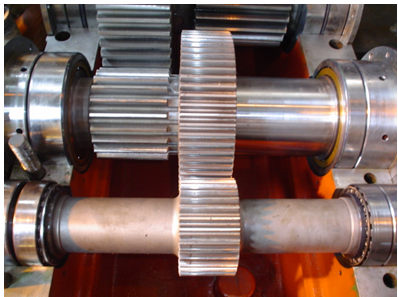
Fig. 6.1 A heavy duty gear box
The study of torsional vibration of rotors is very important especially in applications where high power transmission and high speed are present (Fig. 6.1). Torsional vibrations are predominant whenever there are large discs on relatively thin shafts (e.g., the flywheel of a punch press). Torsional vibrations may originate from the following forcings (i) inertia forces of reciprocating mechanisms (e.g., due to pistons in IC engines), (ii) impulsive loads occurring during a normal machine cycle (e.g., during operations of a punch press), (iii) shock loads applied to electrical machinery (such as a generator line fault followed by fault removal and automatic closure), (iv) torques related to gear mesh frequencies, the turbine blade and compressor fan passing frequencies, etc.; and (v) a rotor rubs with the stator. For machines having massive rotors and flexible shafts (where system natural frequencies of torsional vibrations may be close to, or within, the source frequency range during normal operation) torsional vibrations constitute a potential design problem area. In such cases designers should ensure the accurate prediction of machine torsional frequencies, and frequencies of any torsional load fluctuations should not coincide with torsional natural frequencies. Hence, determination of torsional natural frequencies of the rotor system is very important and in the present chapter we shall deal with it in great detail.