6.1 A Simple Torsional Rotor System with a Single Disc
Consider a rotor system as shown Figure 6.1(a). The shaft is considered as mass-less and it provides torsional stiffness. The disc is considered as thin and rigid (i.e., it has no flexibility). However, it has large polar mass moment of inertia. If an initial disturbance is given to the disc in the pure torsional mode (about its longitudinal or polar axis) and allow it to oscillate its own, then it will execute free torsional vibrations. It is assumed that there is no coupling of the torsional motion and the transverse or axial motion. Figure 6.2 shows that rotor is spinning with a nominal speed of ω and executing torsional vibrations,  , and due to this it has actual speed of
  It should be noted that the spinning speed,ω, remains the same, however, the angular velocity due to torsion has varying direction over a period. In actual practice if we tune the flashing frequency of a stroboscope (it is a speed/frequency measuring instrument based on light source with adjustable flashing frequency) to the nominal speed of a rotor then free torsional oscillations could be observed. For the present case and in most of our analysis, it is assumed that torsional natural frequency does not depend upon the spin speed of rotor. Hence, when the spin speed is zero the natural frequency of the non-spinning rotor will be same as at any other speed. For the free torsional oscillation, the motion will be simple harmonic motion with a unique frequency, which is called the torsional natural frequency of the rotor system.
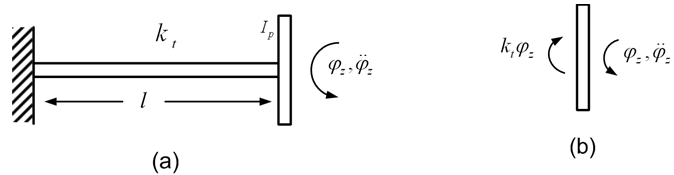
Figure 6.1(a) A single-disc cantilever rotor system (b) A free body diagram of the disc
A single-disc cantilever rotor system under torsional vibration
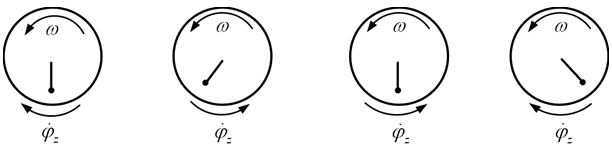
Figure 6.2 Torsional vibrations of a spinning rotor as observed with a stroboscope tuned at ω as the flashing frequency