13.4.2 Influence Coefficient Methods
In a system with large damping or in a system where some rotors are connected to each other as in a steam turbine generator system, the characteristic modes do not appear clearly. In such a case, the modal balancing method is not practicable and the influence coefficient method is used. In Section 13.3.3 we dealt with the influence coefficient method for rigid rotor balancing. In the present section we would extend the method for the flexible rotor balancing in which case influence coefficients themselves depend upon the speed at which the rotor is being operated. Hence, influence coefficients obtained at one speed will no longer be valid for other speeds, and the same is true for the balancing achieved by using the rigid rotor balancing procedure. Figure 13.27 shows the effect of deflection in various modes of the shaft on influence coefficients. It can be seen that they depend upon shaft speeds (especially near critical speeds). For introduction to influence coefficients refer Chapter 8.
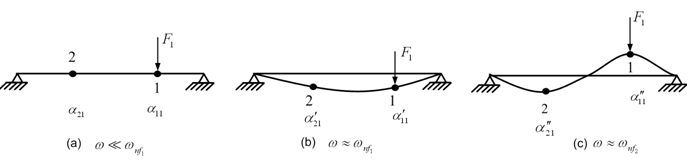
Figure 13.27 Effect of mode shapes on influence coefficients
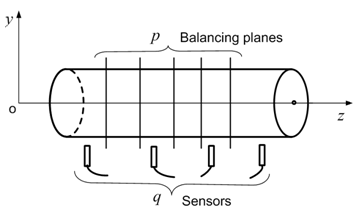
Figure 13.28 A rotor system with measurement locations and balancing planes
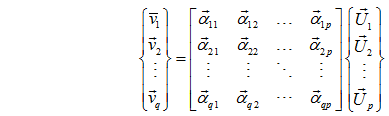
or
|
(13.50) |

where v is the vibration measurement at the measuring plane and subscripts in matrices and vectors represent their sizes.
Measurements are taken at number of speeds. On writing equation(13.50)for each of the speeds, we get
|
(13.51) |
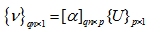
with
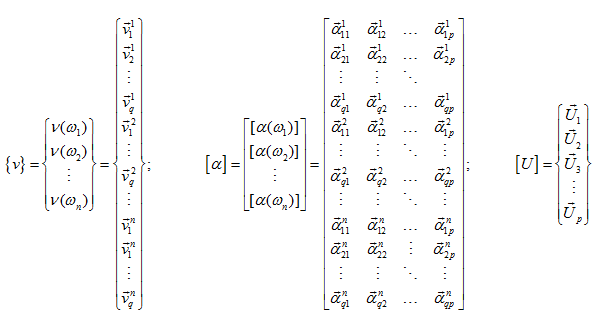
where the superscript represents a particular the speed. Once the influence coefficient matrix  are known for all speeds of interest, equation (13.51) can be used to obtained unbalances, as

or
|
(13.52) |

However, is yet not known and the procedure of obtaining it experimentally is explained in the following.