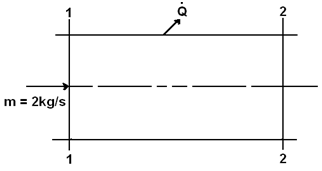
Example 4: A gas is flowing through a pipe at the rate of
2kg/s. Because of inadequate insulation, the gas temperature decreases from
800°C to 790°C between two sections of the pipe. Neglecting pressure
losses, determine the rate of energy dissipation (degradation) due to this
heat loss.
Take To = 300°K, Cp = 1.1 kJ/kg
For the same temperature drop of 10°C, when the gas cools from 80°C
to 10°C, due to heat loss, when would have been the rate of energy degradation.
What inference you can draw from this.
Solution:
| Considering section 1-1 and 2-2 of the pipe. Given Pressure drop Δp = 0 Rate of flow of gas  = 2kg/s, = 2kg/s, Sp. Heat at constant pressure of gas, Cp = 1.1 kJ/kg-K Surrounding temperature, T0 = 300K Temperature at section 1-1, T1 = 800°C = (800 + 273) K = 1073K Temperature at section 2-2, T2 = 790°C = (790 + 273) K = 1063K Due to inadequate insulation, heat is lost through the wall of the pipe. Heat loss, |
|


Keeping the same temperature difference of 10°C both in part I and part II of the problem, it is seen that the rate of energy degradation is less at low inlet-outlet temperatures. Hence energy loss at low temperature is qualitatively different from energy loss at low temperatures. Energy at 800°C is qualitatively superior to energy at 70°C.
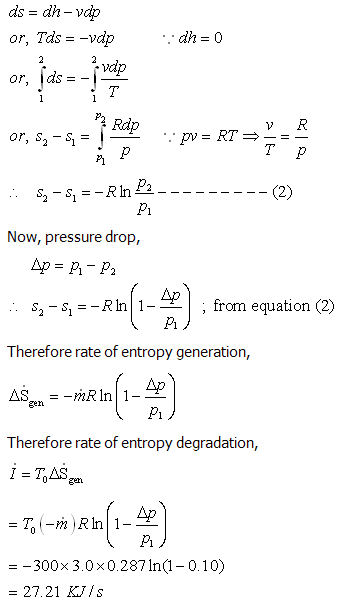
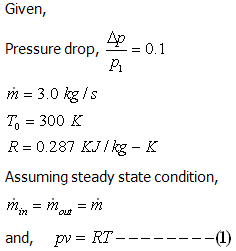
Example 5: An ideal gas is flowing through an insulated pipe at the rate of 3.0 kg/s. there is a 10% pressure drop from inlet to exit of the pipe. Find the energy loss. Take R = 0.287 kJ/kgK, To = 300K.
Solution:
|
|
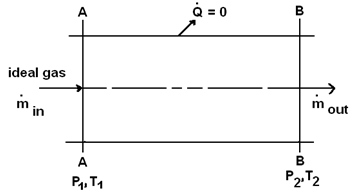
We have,
Kinetic energy change between sections A-A and B-B = 0
Potential energy change between sections = 0
Change of enthalpy between the section, dh = 0
Applying equation per unit mass flow, we get,