Complex convolution:
![$\displaystyle Z[f_{1}(t)f_{2}(t)]=\frac{1}{2\pi j} \oint_{\Gamma} \frac {F_{1}(\xi) F_{2}(z\xi^{-1})}{\xi} d\xi$](images/img111.png)
 circle / closed path in z-plane which lie in the region
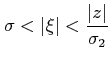
 : radius of convergence of
 : radius of convergence of

2.5 Limitation of Z-transform method
- Ideal sampler assumption
 z-transform represents the function only at sampling instants.
 - Non uniqueness of z-transform.
- Accuracy depends on the magnitude of the sampling frequency
 relative to the highest frequency component contained in the function f(t).
 - A good approximation of f(t) can only be interpolated from f(kT), the inverse z-transform of F(z), by connecting f(kT) with a smooth curve.
2.6 Application of Z-transform in solving Difference Equation
One of the most important applications of Z-transform is in the solution of linear difference equations. Let us consider that a discrete time system is described by the following difference equation.
