2.3 Inverse Z-transforms
Single sided Laplace transform and its inverse make a unique pair, i.e., if F(s) is the Laplace transform of f(t), then f(t) is the inverse Laplace transform of F(s). But the same is not true for Z-transform. Say f(t) is the continuous time function whose Z-transform is F(z). Then the inverse transform is not necessarily equal to f(t), rather it is equal to f(kT) which is equal to f(t) only at the sampling instants. Once f(t) is sampled by an the ideal sampler, the information between the sampling instants is totally lost and we cannot recover actual f(t) from F(z).
![$\displaystyle \Rightarrow f(kT)= Z^{-1}[F(z)]$](images/img101.png)
The transform can be obtained by using
- Partial fraction expansion
- Power series
- Inverse formula.
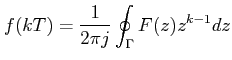
The Inverse Z-transform formula is given as:
2.4 Other Z-transform properties
Partial differentiation theorem:
![$\displaystyle Z \left[\frac{\partial}{\partial a}[f(t,a)]\right]= \frac {\partial}{\partial a} F(z,a)$](images/img104.png)
Real convolution theorem:
If f1(t) and f2(t) have z-transforms F1(z) and F2(z) and f1(t) = 0 = f2(t)
for t < 0, then
![$\displaystyle F_{1}(z)F_{2}(z)= Z\left[\sum_{n=0}^{k} f_{1}(nT)f_{2}(kT-nT)\right]$](images/img110.png)